Occupational Therapy for Adults

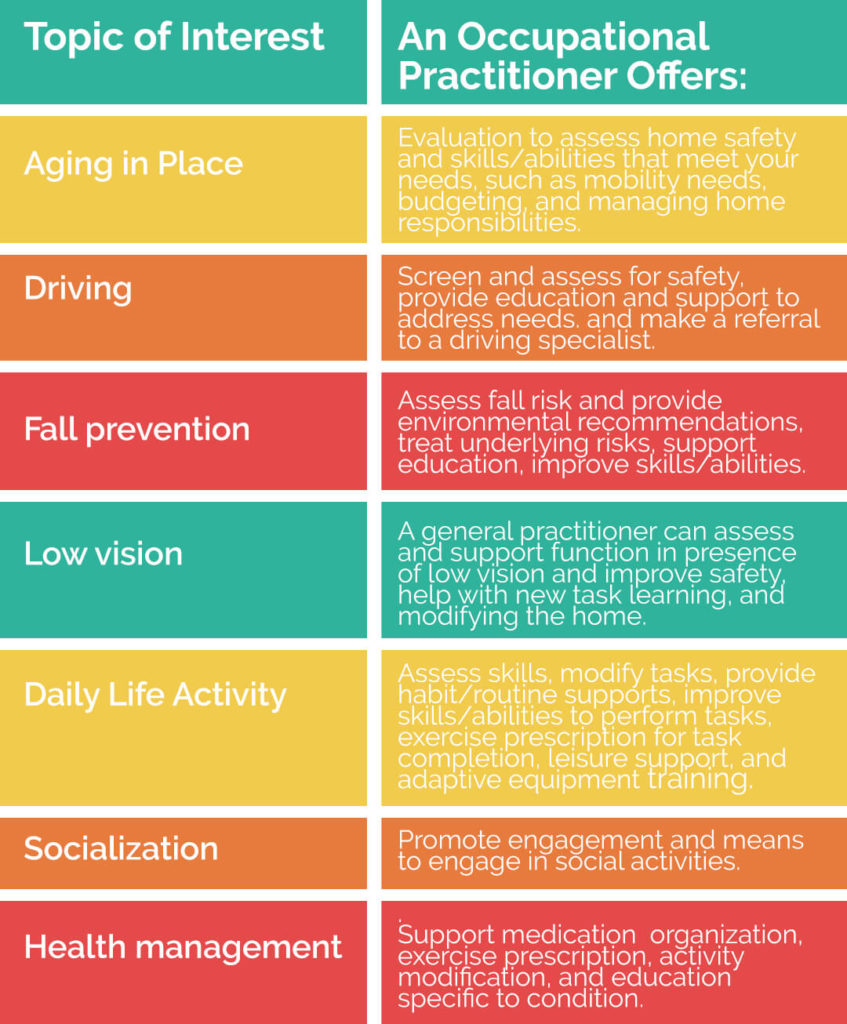
In our community, Occupational Therapy for the older adult population is typically relegated to upper extremity orthopedic issues or severe neurological conditions. Occupational therapy practitioners are uniquely qualified to provide a variety of services to older adults because they have an excellent understanding of human activity, daily activity, and function in addition to the knowledge they acquire to treat medical conditions.

Occupational therapists use a variety of tools and training to address the following concerns experienced by older adults:

  • Lifestyle changes
  • Cognitive changes or decline
  • Chronic pain
  • Mental health changes
  • Leisure promotion
  • Low vision or vision changes
  • Community mobility concerns including driving

The Lifestyle Redesign® program, activity and occupation-based interventions, and functional cognitive approaches are all excellent programs to use while working with adults to provide an all-encompassing treatment experience. However, addressing fall prevention, community safety, daily activity participation, and well-being are the tip of the iceberg for OT treatment options. For example, topics from the Lifestyle Redesign® program include Health and Aging, Transportation, Finances, Relationships, and Home and Community Safety. Functional cognitive approaches include completing a cognitive profile of an individual and assisting clients to develop strategies to address function, provide cognitive retraining, or assisting clients and caregivers in working within cognitive impairment needs.

So, if you are interested in learning more about occupational therapy for adults, please reach out to MOSAIC Health & Rehab.

References
  1. Clark, F., Jackson, J., Mandel, D., Nelson, L., Zemke, R. (1999). Lifestyle Redesign: Implementing the Well Elderly Program. Bethesda, MD: AOTA Press.

Holiday S.T.E.M. Activity: Edible Stained Glass

The holiday season is known for the abundance of food and treats. Therefore, this edible stained glass holiday S.T.E.M. activity is a great choice! You will need a base understanding of geometry for this activity. This activity can use premade or store bought candy that is melted, or you can make your own candy.

As previously stated, there are two ways in which one could make stained glass. The first is by making your own candy using corn syrup, sugar, water, and a candy thermometer. The other option is to use store bought hard candy (i.e. jolly ranchers) and slowly melt them down to a liquid state.  We will explain both methods.

What You Need for Holiday S.T.E.M Edible Stained Glass:

  • Hard candy (either homemade or store bought)
  • Egg whites from 3 large eggs
  • 1 tsp of vanilla extract
  • 4 cups of powdered sugar
  • ½ tsp of cream of tartar
  • Pretzel sticks and/or rods

Tools Needed:

  • Candy thermometer
  • Heavy metal bottomed pot
  • Wooden spoon
  • Stove
  • Mixer
  • Measuring cups and spoons
  • Aluminum foil
  • Heat safe surface
  • Piping bag

Preparing your stained glass:

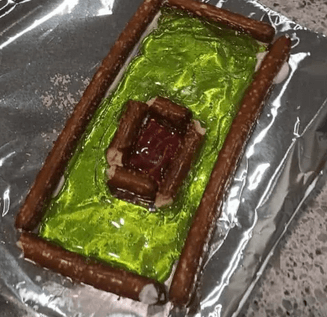
Make sure you talk with your child about safety when using hot products. Give each child a heat safe surface covered in aluminum foil. You can use a plate or piece of cardboard. Using the pretzel rods and sticks, have your children map out a frame for their picture. Older kids can do this on their own, and younger kids can follow a printed picture or one outlined in marker. Make sure that all sides connect to make it more difficult for the liquid to flow out and escape the frame.

Royal Icing:

Firstly, you will make the royal icing. Combine egg whites, vanilla, and cream of tartar in a bowl. Mix until frothy. Add the powdered sugar slowly and incorporate it completely. Mix until glossy and peaks form (this will take about 5 minutes). Put the icing in the piping bag. Take your already made template (pretzel structure), and glue down all the pretzels with the icing. Finally, do your best to make sure that there are not any gaps between the pretzels. If you use jolly ranchers, place one jolly rancher into each gap in your picture until every space fills up. This will let you know how many jolly ranchers you will need.

Melting the Jolly Ranchers:

  1. Take all of your like colored jolly ranchers and unwrap them. You may want to add a few extra to be safe. Place into a microwave safe bowl.
  2. Place in microwave and cook at 50% power for no more than 2 minutes at a time.
  3. Mix and melt until you have reached a “molten glass” consistency.
  4. Spoon into appropriate spaces on your template. If you have several templates, try not to do too many at once, as the candy will begin to harden.
  5. You may need to remelt your candy, but keep in mind that if your candy is too thin (not as much volume) you will need to melt in 30 second intervals to avoid burning.
  6. Repeat until all your colors are done, and your template is complete.

If you did your project properly, once it cools, you should be able to lift it off and let the light shine through.

holiday s.t.e.m.

What can be learned from this holiday S.T.E.M. activity?

This holiday S.T.E.M. activity is all about geometry! We use geometry every day. We may not even know it! Firstly, we use geometry to build houses. We use geometry to figure out how many groceries will fit in the trunk of your vehicle. Study art history. See how stained glass has been used throughout time. In addition, research how real stained glass is made, or modify this activity with cookies.

Finally, for more fun activities to do with your kids, check out Hess Un-Academy or MOSAIC’s Holiday Mad Lib and Christmas Scavenger Hunt.

Caring for Dementia

Being a family member and/or care partner of someone with a neurological impairment, specifically dementia, can be beautiful and fulfilling. However, caring for dementia can be exhausting at the same time. Around the year 1990, Teepa Snow began the early stages of developing a program referred to as the Positive Approach to Care. It would become world renowned in teaching and training care partners and clinicians how to positively interact with those suffering from a neurological impairment. This makes caring for people with dementia easier.

Teepa stresses the importance of developing a way to communicate with loved ones when verbal communication and typical interactions change secondary to changes occurring in the brain. Teepa stresses the importance of including meaningful activities to fill this person’s day. Specifically, Teepa’s approach surrounds 5 main activities that should always be the focus of intervention for the individual.

5 Things for Caring for Dementia

Firstly, provide activities similar to “work” that allow the individual to be productive. Teepa believes work allows all people to feel value in what they are contributing to others. This leads to feeling value within themselves.

Secondly, provide leisure activities. All humans find and incorporate hobbies into their daily routine, simply because they like them and they bring them joy. Check out these Festive Activities for Family Members with Dementia for ideas to provide leisure activities. It can be modified for other celebrations or day to day activities.

The third activity is self-care. This includes all personal things we need to take care of for optimal safety, health, hygiene, and independence.

Last, but not least, the fourth activity Teepa stresses is rest and restoration. All humans, no matter the personality trait, require participation in activities that will help them feel recharged, essentially filling their cup up.

Because of Teepa’s knowledge and framework, she has been educating care partners and clinicians on the most positive and fulfilling ways to engage and care for your loved ones.

**We do not own the rights to this information. The content is original and copyrighted to Teepa Snow. It has been adapted to highlight and provide information to our readers. For best practice of Teepa’s information, please visit her website here.

Infant Play Activities

You just got home with your new bundle of joy and now you can feel the pressure of making sure you meet all of the demands of raising a child. Between all of the snuggles, feeding, and diaper changes, it is important to let your baby have some tummy time and play time. How do you play with a newborn? Below is a list of eight fun infant play activities you can easily do at home. But first, let us talk about why play is important.

Play is simple. You do not need to run to the store to get the latest and greatest marketing scam. When it comes to baby play, follow the rule of “less is more.” Your child does not need loud music toys, for that matter, any battery operated toy.

Babies learn about the world through all of their senses. When playing with babies think about how to make your child hear, touch, smell, see, or taste something new or different. When you engage their senses through talking, reading, singing, and playing, more neural connections form and development occurs.

Your care and undivided attention is required to ensure that your baby is safe, though these activities will give you a minute to enjoy a cup of coffee or just take a minute to breathe.

Infant Play Activities

The Sensory Bag

This is a versatile activity that can be tailored to any age baby. (Pictured Above)

What you need: Gallon Ziploc bag and fillers such as water, ice, beans, and/or rice. What to do: Go crazy and use your imagination. Add something fun and colorful, such as pompoms, glitter, or beads. Make sure to avoid sharp objects that might pierce the bag or hurt little fingers. For 0-4 months, tape the bag down on the floor with durable tape (like duct tape) for tummy time. For a sitter or stander, tape the bag to the wall or door and have them play in sitting or standing. 

Black & White Cards

What you need: White paper or card stock and a black sharpie. What to do: Draw shapes, stripes, and designs on the white cards. You can paste these cards on a tissue box or shoe box so they stand independently OR just prop them up for something interesting and engaging to look at during tummy time. Pro tip: You can download free templates from Pinterest and print them out! Or use any high contrast books that you have!

The Book Circle

What you need: Board books. What to do: In tummy time, place books around your baby in a semicircle. This is something fun and engaging to look at, It encourages visual tracking as well trunk and neck rotation.

Ribbons or Loofah Hanging from Play Gym

What you need: Ribbon or bath loofahs and a play gym. What to do: Tie colorful ribbons or loofahs to the play gym so they hang down right in front of the baby. They will have fun grabbing and swatting at these fun objects.

White Lights in a Box

What you need: A cardboard box, white lights, and a knife or screwdriver. What to do: Cut off one side of the box to create a nice open environment. Then use a knife or screw driver to make little holes in the top of the box. Finally, poke the lights through the top of the box. This is a very stimulating and engaging environment for your sweet baby.

Infant Play with Mirrors

What you need: A mirror and some toys. What to do: Babies LOVE looking at themselves! Place the mirror on the floor with some different toys and let your baby play on their tummy.

Balloon on the Foot/Hand for Infant Play

What you need: A helium balloon and string or ribbon. What to do: Tie the balloon to your baby’s foot or hand. Watch them kick and play and learn the very beginning stages of cause and effect.

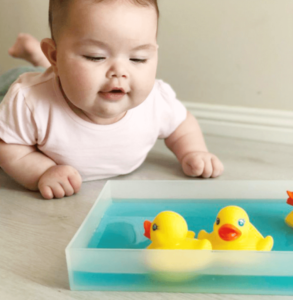
Ducks in a Pan

What you need: A shallow plastic bin or cookie sheet, rubber ducks or other rubber bath toys, a play mat, and a towel. What to do: This is a great activity to extend tummy time. Your baby can splash in the water, grab at the ducks, and just have a great sensory experience. Close supervision required! 

These fun infant play activities for babies will help make tummy time more enjoyable and increase how long they can stay on their stomach. This activity list creates a lot of sensory experiences and really fosters opportunities for growth and learning. And remember, keep it simple!

Click here for more play ideas for newborns.  To learn more about play, check out Exploring through Sensory Play.

Six Primary Communication Functions of AAC

The number of topics an individual communicates about each day is extensive. Communication helps us form and maintain relationships, express likes/dislikes or wants, ask and respond to questions, etc. These skills are just as important for individuals who use augmentative and alternative communication (AAC) systems as they are for you or me. Similar to us, individuals who use AAC require access to language on their communication systems. They require support to develop these skills. They also require the opportunity to communicate using these skills. There are six primary communication functions of AAC that we use.

Six Primary Communication Functions of AAC

Requesting

Individuals use requesting in a variety of ways. This includes: requesting a preferred individual (e.g., “mom” or “dad”) or activity, gaining someone’s attention, or communicating a basic want or need (e.g., “food, drink,” or “bathroom”). Requesting can indicate a food/drink order, someone we want to speak to, a place we want to go, or a game we want to play.

Protesting

Similar to requesting, individuals use protesting to reject or decline things that they do not want. This might include: a food/drink that we do not want, an activity, or a chore that we do not wish to do. While protesting can sometimes be considered inappropriate (e.g., skipping school or work), it is something that we use our words or actions to effectively communicate.

Describing

Describing explains the things that we see by labeling or explaining our wants and needs. For example, we may label our list of items for the grocery store or the ingredients that we need to make cookies. By using labeling and describing, we increase our ability to communicate more successfully.

Asking and Responding to Questions

Asking questions includes use of the five “wh” questions: “who, what, where, when,” and “why.” We also use “how, can, do, are you,” as well as “yes/no” in order to ask and respond. Individuals use questions in order to gain information about a topic or person. When someone asks us a question, we answer by providing enough details to appropriately respond. We ask and respond to questions to share our thoughts and ideas. This results in a communication exchange between two or more individuals.

Commenting

Individuals use commenting in order to remark on what they see, feel, hear, or otherwise experience (e.g., taste). For example commenting with “yum” after tasting something good, or saying “whoa” or “wow” when experiencing surprise. Commenting may also be used to indicate a like or dislike (e.g., a favorite color). It is used to provide basic information in a clear and concise manner.

Expressing Feelings

An individual uses communication to express their physical and/or emotional state (e.g., “happy, angry, sick, tired,” or “in pain”).  If in pain, or sick, we use communication to specify how or why we feel the way we do. If we are excited, we explain what is making us feel that way.

In summary, we use these primary communication functions to help us effectively and efficiently communicate. You may notice that several of these functions overlap, or coincide with one another. For example, you can express that you are sick, then respond to questions about “how” or “why” you feel sick. If you comment on how you like something, you can also use communication to request a repetition. The communication functions listed above are continuously used throughout our day. This is why it is important to support individuals who use AAC systems to communicate using these functions.

Vocabulary provided to individuals on their AAC systems should be intentional. This includes what is important to the individual and/or their caregivers. Preferred objects or persons are most likely to be used for individuals who are in the stage of language development and have not yet expressed a “first word.” Also, being able to communicate medical needs is an important skill to address when applicable. In general, including vocabulary on an AAC system that can meet the need of all six communication functions is crucial. Check out additional resources from Autism Classroom, Cornerstone Autism Center, and Communication Community. If you or someone you know needs additional support we AAC, our speech therapists at MOSAIC can help!

Reference
  1. Beukelman, David R., and Pat Mirenda. Augmentative and Alternative Communication: Supporting Children and Adults with Complex Communication Needs. Paul H. Brookes Pub., 2013.

Why Sequencing is Important

What is sequencing, and why is it important? We use sequencing as a part of our daily routine. It involves ordering events based on their chronological timeline. Essentially, these are the steps that we use to complete a task (e.g., hand washing or following a recipe). For example:

Washing Hands:

  1. Wet hands
  2. Put soap on hands
  3. Lather hands with soap and water
  4. Dry hands with towel

While this may seem fairly straight forward to most, several individuals with developmental delays and/or young learners experience difficulty with sequencing. As a result, they may need explicit instruction on how to complete a routine.

Why is it Important?

The ability to sequence tasks and understand information in a chronological manner is critical to development of literacy skills. Target literacy skills include: the ability to identify the beginning, middle, and end of a story, making a prediction for “what will happen next?’ in the story, and retelling or summarizing a story in a sequential manner.

The most basic level of sequencing exists in functional routines (e.g., washing hands or getting ready for school/work). Most individuals acquire a rote means of completing a functional routine without needing to reference a picture or visual. However, the development of these skills evolves from functional routines to higher-level language functions including:

  • Understanding cause and effect
  • Following multiple step directions
  • Narrative skill development
  • Understanding and using transition words (e.g., “first, second, then, next, last, finally)
  • Reading and writing
  • Learning schedules and creating them
  • Organizing information
  • Time management skill development

Sequencing skills are targeted throughout nearly every level of the school-aged (i.e., kindergarten through 12th grade) academic curriculum. A strong foundation for the above higher-level language functions is essential for understanding and using information covered throughout the curriculum.

How is Sequencing Taught?

Therapists often implement picture cards to teach or improve sequencing abilities. This includes a picture representation of each step in order to complete a task. Once the learner can sequence a task using the pictures, the visuals are often removed. Instruction remains ongoing until the person can complete the task independently.

Sequencing or picture cards can be used not only in speech therapy, but across other therapies, at school, or at home. Not all sequencing cards come in picture form. Higher level learners who have developed reading skills may benefit from text cards. A great example of this is a recipe card. Aside from sequencing cards, graphic organizers or timelines are also used to target sequencing skills.

If you have concerns about your child’s ability to sequence and complete tasks, call MOSAIC today to schedule an evaluation with one of our speech therapists.