
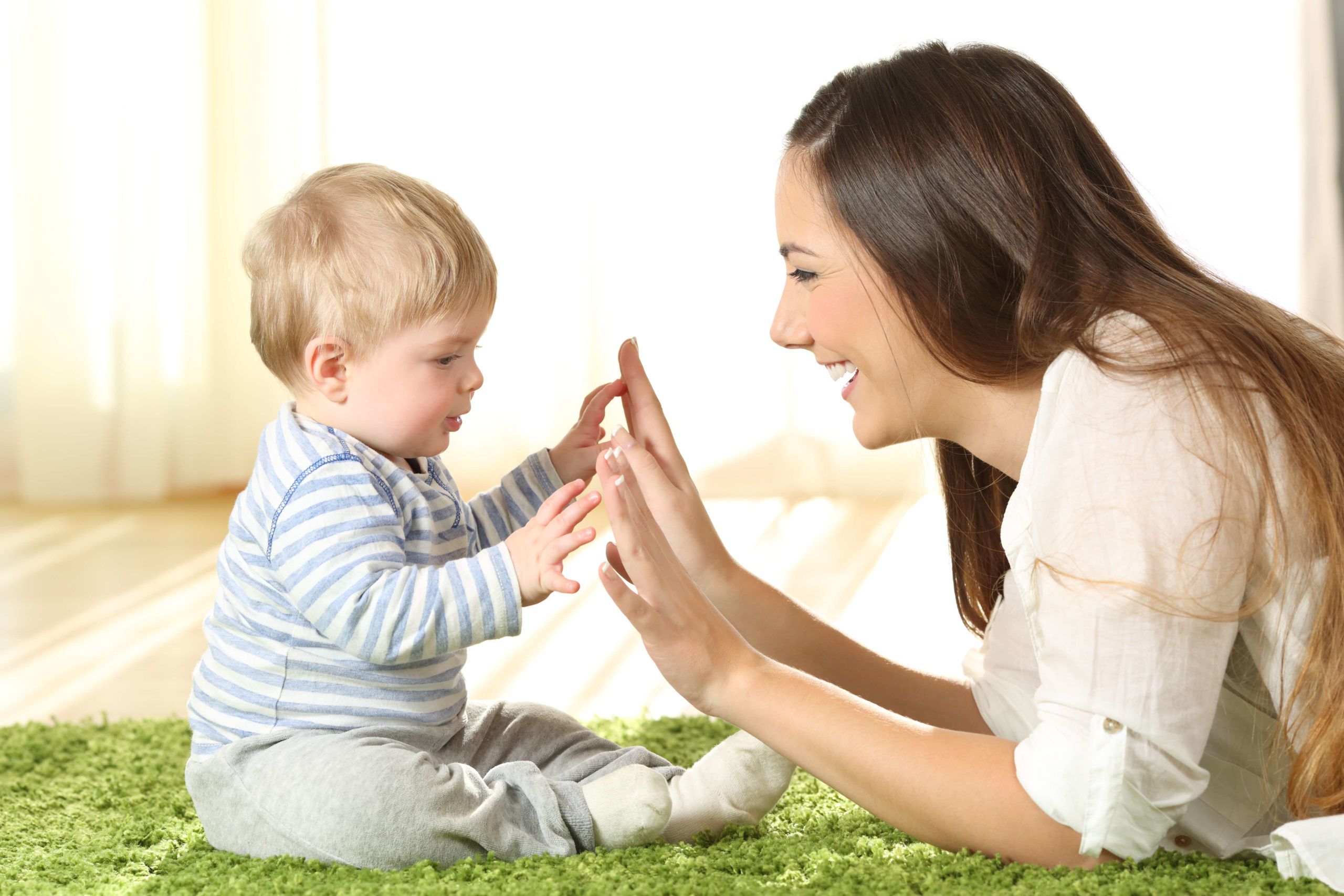
Is My Child Ready to Start Talking?

Before the development of first words, children need to be using and pairing prelinguistic or “pre-language” acts consistently. Prelinguistic communication includes meaningful use of gestures, imitation, vocalizations, and eye contact to communicate. Children must also achieve: joint attention, shared enjoyment, communication intent, persistence, and social referencing before being able to use verbal language functionally to communicate.

What Does That Mean?

  1. Joint Attention: a child’s ability to follow eye gaze, point, or gesture from a person which leads to both the child and communication partner paying attention to the same object
  2. Shared Enjoyment: when a child shares a feeling with another person, for example, a child hears a funny noise, begins to laugh, and then looks to communication partner to laugh with them and confirm they enjoyed the noise as well
  3. Communication Intent: a child’s ability to use purposeful forms of communication (gestures, vocalizations, eye contact) to get a message across to someone
  4. Persistence: a child’s ability to continue communication attempts when their message is not being conveyed, for example, if a child is vocalizing “uh uh uh” and gets no response and they then lift their arms up to signify they want to be picked up
  5. Social Referencing: a child’s ability to pick up messages from people around them to help guide how to act appropriately, for example, a child looks at communication partner to see if it is okay to crawl down the stairs (children should be aware of cues others are giving, such as a scared facial expression)

How Prelinguistic Skills Develop

As soon as a baby is born they begin looking and listening. Babies watch their mother’s faces and begin to discriminate and recognize which faces are important.  Eye contact allows babies to learn and gain information about language from their caregiver’s mouth and face. Additionally, listening helps babies to recognize important voices which they begin responding to. Babies and children who do not have good eye contact will have less opportunities to hear the words and language being used and less opportunities to attach meaning to these words.

From birth, babies are also building up the understanding that facial expressions and gestures carry meaning. Babies begin smiling at around 6 weeks of age. This continues to foster social interactions because adults will initiate more communication with responsive babies. By 3 months of age babies start to show anticipation and excitement at the sounds/words associated with different situations. These can include approaching voices, dog barking, running bathwater, etc. Turn-taking and copying develops between 6-9 months, where babies are able to copy hand motions such as clapping and vocal sounds such as “bababa” or lip smacking. Joint attention develops between 9-12 months where children begin pointing to show others events or objects which are of interest. This further reinforces and encourages adults to engage with the child by naming these objects and events and expanding the information they provide.

What Happens When Prelinguistic Skills Are Not Present?

Children who have difficulty with joint attention will have fewer opportunities to learn about things in their environment. Children learn and attach meaning to words by looking at what an adult is showing them and talking about what they are seeing. Non-verbal and verbal language remain intertwined throughout all language learning processes. Meaningful verbal language will not develop without first, the development of prelinguistic skills. Children who are not developing prelinguistic skills appropriately may not do these things:

  • Give eye contact
  • Respond with a smile
  • Use different vocalizations to indicate different emotions
  • Babble
  • Copy facial expressions or gestures
  • Use vocalization or gesture to gain attention
  • Attempt to show you things in their environment
  • Enjoy others participating in their play

How To Promote These Skills

  • Encourage Eye Contact
    • Get face to face with your child and position toys at eye level
    • Sit across from your child when reading and hold books near your face
    • Hold desired objects close to your face and do not give them to your child until they look at you to “request” it
    • Play peek a boo
  • Use Gestures
    • Wave hi/bye
    • Point when you say look to show your child what they should be looking at
    • Shake head “yes” or “no” when using these words
  • Practice joint attention – If your child has difficulty following your point, start with your finger close to their eyes and draw it out to the item you want them to look at
    • Point to and label items in books
    • Point out different things within your environment and encourage your child to look at them
    • Follow your child’s gaze and talk about what they are looking at

If your baby is not using these prelinguistic skills consistently by 10 months of age, you may want to see a speech-language pathologist to help promote your baby’s pre-language skills as they are necessary precursors for spoken language.

Single Leg Balance in Kids

Here are some statistics about single leg balance:

  • By 36 months, 50% of children can balance on 1 leg for 3 seconds with their hands on their hips.
  • By 42 months, 50% can hold single leg balance on 1 leg for 5 seconds with hands on hips.
  • 50% can hold single leg balance for 6 seconds on each leg with less than 20 degrees of trunk movement side to side with hands on hips by 54 months.
  • By 5 years of age, 50% can hold single leg balance for 10 seconds on each leg with less than 20 degrees of trunk movement side to side with hands on hips.

Why is Single Leg Balance Important?

So your child should be able to balance on 1 foot. But why do we care? Single leg balance is a building block for more advanced skills that your child will develop as they get older. These skills include: kicking a ball, hopping, and skipping. It is also used during functional activities, such as putting on pants/shoes and stepping in/out of the bathtub/shower.

Better balance promotes better body awareness, which improves safety and can also lead to more success when playing sports. There is also evidence that poor single leg balance is linked to higher risk of ACL injuries in females. Ability to hold single leg stance is one indicator that the vestibular system (sensory system that provides a sense of balance and spatial orientation for the purpose of coordinating movement with balance) and proprioceptive system (sensory system that informs us of where our body parts are at in relation to other body parts) are well-integrated, which is necessary for a child to sit still, listen, and focus their eyes, skills required for learning.

Ideas For Working On Single Leg Balance

  • Make sure your child is able to stand with their feet together without falling.
  • Practice kicking various size balls.
  • Practice stepping over a string or a stick. Start low (2-3”) and gradually increase the height. Alternate having your child step over with right foot first and then left foot first.
  • Show your child how to balance on one leg with their arms out to the side. You may need to start by holding one of their hands and help them hold one of their legs up in the air. Alternate which foot your child is standing on. Gradually decrease your support as able.
  • Practice balancing on 1 leg with hands on hips and then with eyes closed.
  • Practice putting pants, shoes, and socks on in a standing position. Have your child hold on to a wall for balance if needed at first.

Ideas to Make it FUN!

  • Stand with 1 foot on a ball
  • Pop bubbles while they are in the air with your foot
  • Balance small stuffed animals, cars, etc. on the top of the foot, and lift them up and drop them in a basket
  • Play balloon volleyball with your feet
  • Practice in the pool
  • Pretend to be animals like a stork or flamingo
  • Play hopscotch

Check out Gross Motor Milestones: Kneeling to learn what your child should develop next. If you have concerns regarding your child’s balance or if they fall frequently, contact MOSAIC Health & Rehab for additional suggestions or for a free screen. To learn more, check out this great milestone moments list from the CDC.

Developmental Communication Milestone Series: 4-8 Months

communication 4 to 8 monthsWhat does communication at 4 to 8 months of age look like? Before babies can talk, they begin to understand language and words. At this stage, babies are beginning to recognize basic emotions, words, and gestures. They show preferences and interests by their facial expressions, the sounds they make, and their actions.

At 8 months of age, babies should be using a wide variety of sounds. Many sounds are just exploratory while others begin to have meaning and are used repeatedly. Babbling begins to resemble the quality of language people speak to them during daily routines. Babies begin using their own gestures in imitation of the ways they see their caregivers gesture to communicate. By 6-8 months of age, babies should also be using prelinguistic communication skills. These include eye gaze, gestures, and vocalizations consistently to make their wants and needs known. They should also be pairing these skills consistently in meaningful communication attempts.

What communication should babies have by 4 to 8 months?

  • Look toward mother when asked, “Where’s mommy?” or look for bottle when asked, “Where’s bottle?”
  • Look worried when someone speaks in a stern voice
  • React to caregiver’s facial expressions
  • Participate in games such as peek-a-boo
  • Become excited when they hear a familiar word such as “bottle” or “kitty”
  • Lift arms toward you when you ask “down?” or “up?”
  • Look away when they don’t want to eat any more
  • Wave hi/bye

Vocally babies should be:

  • Copying nonverbal sounds such as cough or kiss sound
  • Spontaneously babble repeated consonants such as “da-da-da”
  • Repeat consonant sounds such as “ma-ma-ma” or “ba-ba-ba”
  • Babble different consonants such as “ga-da-ba”
  • Vocalize sounds along with someone who is singing to them

Your baby may need additional support if:

  • Baby is not looking toward family members when they hear their name
  • Baby does not look around to find who is speaking to them or when their name is called
  • Pays little attention to and does not initiate joint attention games such as peek-a-boo
  • Makes only a few sounds
  • Not attempting to imitate non-verbal sounds and early consonant sounds
  • Does not imitate hand movements or gestures (waving bye, playing patty-cake)

Check out 12 Month Communication Milestones to learn what your child should develop next. If you have questions or concerns about your toddler’s speech development, call MOSAIC Rehabilitation at (406) 388-4988. We offer free 15 minutes screens and are happy to answer any questions you might have.

Understanding Dyslexia

For dyslexia, early identification of both strengths and weaknesses is key to success with education. Dyslexia is often seen as a disadvantage. When it is viewed as a different way of thinking, this thinking can lead to success. Understanding dyslexia can help make learning easier.

HOW DYSLEXIA AFFECTS LEARNING

Reading

Difficulty recognizing and manipulating sounds, letters, and words makes learning to read difficult. Once reading is grasped, children who are dyslexic often remain slow readers.

Understanding dyslexia can help with Memory Systems

Problems with memory systems can affect all learning. Memory systems include: Verbal Memory (remembering verbal instructions), Sequential Memory (ordering facts and information), Working Memory (keeping facts in mind in order to manipulate them), and Visual Memory (recognizing symbols, letters and words).

Spelling, Grammar & Punctuation

To excel at spelling, grammar, and punctuation, you have to learn to retrieve a series of information, skills, and rules. Children with dyslexia have difficulty with memory systems, making it difficult for them to learn and apply these skills and rules.

Math

Children with dyslexia struggle with sequential and working memory, making it difficult for them to learn and remember multiplication tables. Memory problems make it difficult for them to do mental arithmetic, although they are often very good at conceptual, higher level math. Therefore, it’s essential to identify dyslexia in order to nurture higher level math skills.

Understanding How Dyslexia affect exams

Memory difficulties make recalling facts difficult, particularly when under pressure during tests. The removal of coursework and speaking and listening from exams is disadvantageous for kids with dyslexia. They excel in the reasoning and exploring skills applied in coursework and have strong verbal reasoning and communication skills. When we remove these elements from exams, we limit the opportunity for kids with dyslexia to demonstrate their knowledge and understanding of a subject.

Unlike non-dyslexics, literacy is not automatic for a child with dyslexia. They constantly have to think about every action and process, then put them all together in quick sequence to complete their work. As a result, it takes kids with dyslexia approximately five times longer than others to complete literacy tasks. This is why allowing extra time to take exams is essential for all children with dyslexia. Research by U.S. universities has found that extra time often dramatically impacts grades.

Understanding dyslexia is critical for learning success. MOSAIC can help you provide assessment and intervention for children whose language difficulties involve problems in learning to read and write. These reading and writing difficulties may occur independently of obvious deficits in spoken language or comprehension of oral language.

Vision and Your Baby

Tummy Time and Visual Development

There is a wealth of knowledge on tummy time and its importance for motor development and strengthening. Do you how important tummy time is for the visual system, though? If babies do not get enough tummy time, parents may notice delays in crawling, vision development, and other learning disabilities. So, let’s take a look at how a baby’s vision develops.

Additionally, babies learn to see over a period of time, much like crawling and walking. It is important to have healthy eyes and good vision in order to promote the development of “seeing.” To support this development of seeing, it is important that a variety of activities are provided to build and refine vision.

Development of Visual Skills

Vision: Birth to 4 Months

In the first couple of months (birth to 4 months), a baby’s eyes and visual system develop significantly. A baby’s initial primary focus is within 8-10 inches away from their face. Furthermore, they can appear to stare intently at high contrast items. They still are not able to tell the difference between two different items, though.  A baby’s eyes start working together in the first couple of months and vision improves drastically. Then, at around 3 months of age, they begin to figure out eye-hand coordination as they track and learn to reach for items.

Vision: 5 to 8 Months

Around 5-8 months of age, the coordination of eye movements and eye-body movements are being refined. It isn’t until the fifth month of life that the eyes are working together, and babies begin to observe the world in a 3-dimensional view and see things in-depth. By 6 months, a baby is able to hold their head still while using their eyes to look around the room. The emergence of crawling, typically around 8 months, continues to develop and refine eye-hand-foot-body coordination.

Vision: 9 to 12 Months

By 9-12 months of age, a baby can judge distances fairly well and throw items with precision. Babies at this age should be able to pick up smaller items with a fine pincer grasp. Babies will begin to pull themselves to stand and may also begin to learn how to walk, but parents should also continue to encourage crawling as this helps solidify and strengthen eye-hand coordination skills.

Vision: 1 to 2 Years

By 1-2 years of age, a child’s depth perception skills and eye-hand coordination are well developed. Children at this age are learning by watching and listening to all the things happening in their environment, and they will recognize objects and pictures that are familiar to them.

Importance of Tummy Time

After looking at the visual system and how it develops in an infant, we can conclude that tummy time is critical for the development of the visual system. Without tummy time, the body will have weak core muscles. This will delay head control and result in an inability to hold their head steady, causing a child to see blurred images because they cannot control their eye movements. Strong core muscles allow the head and neck to work together with the eyes to locate and track objects.

If you have questions or concerns about your child’s vision, contact MOSAIC Rehabilitation.

References
  • www.colemanvisioncenter.com/lack-of-tummy-time-could-cause-learning-delays
  • www.clarendonvision.com/childrens-vision/know-childs-vision
  • www.friendshipcircle.org/blog/2013/08/01/how-tummy-time-can-help-develop-your-babys-sensory-system
  • www.motherhoodcenter.com/blog/parenting-blog/the-importance-of-tummy-time
  • www.aoa.org/patients-and-public/good-vision-throughout-life/childrens-vision/infant-vision-birth-to-24-months-of-age?sso=y
  • ilslearningcorner.com

Developmental Communication Milestone Series: Birth To 4 Months

communication birth to 4 monthsWhat does communication from birth to 4 months of age look like? During the first few months of life, babies begin to demonstrate the ability to respond to and initiate interactions with those around them. Some of the ways babies attract interactions and pay attention include: looking at people around them, crying, smiling, and clinging to caregivers. These are the earliest forms of communication. Babies learn to be excited when they hear your voice because they begin to learn this means they may be picked up or someone may play with them.

Crying is the main way young infants communicate. Babies may cry to communicate to let caregivers know that they are hungry, need a diaper change, or just want company. As babies begin to explore their voices, cries turn into gurgles and babbles. Usually between birth and four months of age, babies begin to laugh out loud for the first time. Babies use their whole body to communicate including their eyes, hands, legs, and feet to express happiness, excitement, or displeasure. By paying attention and responding to babies’ communication attempts, babies start to learn that they can let people know what they want.

What communication should babies have from birth to 4 months?

  • Gaze into caregiver’s eyes while being fed
  • Turn head to familiar voices
  • Stop crying when they hear caregiver’s voice or familiar voice calling to them
  • Look intently and stop kicking legs and moving arms when a family member speaks to them
  • Quiets and seems to “listen” when music is played softly
  • Smiles or coos when talked to
  • Follow caregivers with their eyes
  • Cry or fuss to gain attention

What Babies Should Be Doing Vocally

  • Making babbling or cooing sounds or waving arms or legs when a person speaks to or smiles at them
  • Practice a consonant sound repetitively while lying on their back (ex: dadadada)
  • Vocalize or make babbling sounds at their rattle or swinging mobile
  • Cry in different ways for different needs

Signs Your Baby May Need Additional Support

  • Baby does not respond to sound of familiar voices
  • Baby shows little or no reaction to seeing their bottle
  • Baby does not seem to show recognition when caregiver approaches with outstretched arms
  • Baby continues to search in several directions when they hear a familiar voice and cannot localize sound
  • Baby stops crying briefly when they hear a familiar voice, but then resumes crying and cannot be calmed
  • Baby looks but does not respond when someone talks to them
  • Baby shows little interest in the movement and music of a mobile over the crib
  • Baby does not cry in different ways to signify hunger, tiredness, need for diaper change, etc.
  • Baby is not vocalizing or makes only a few babbling/gurgling sounds

Check out 4-8 Month Communication Milestones to learn what your child should develop next. If you have questions or concerns about your toddler’s speech development, call MOSAIC Rehabilitation at (406) 388-4988. We offer free 15 minutes screens and are happy to answer any questions you might have.