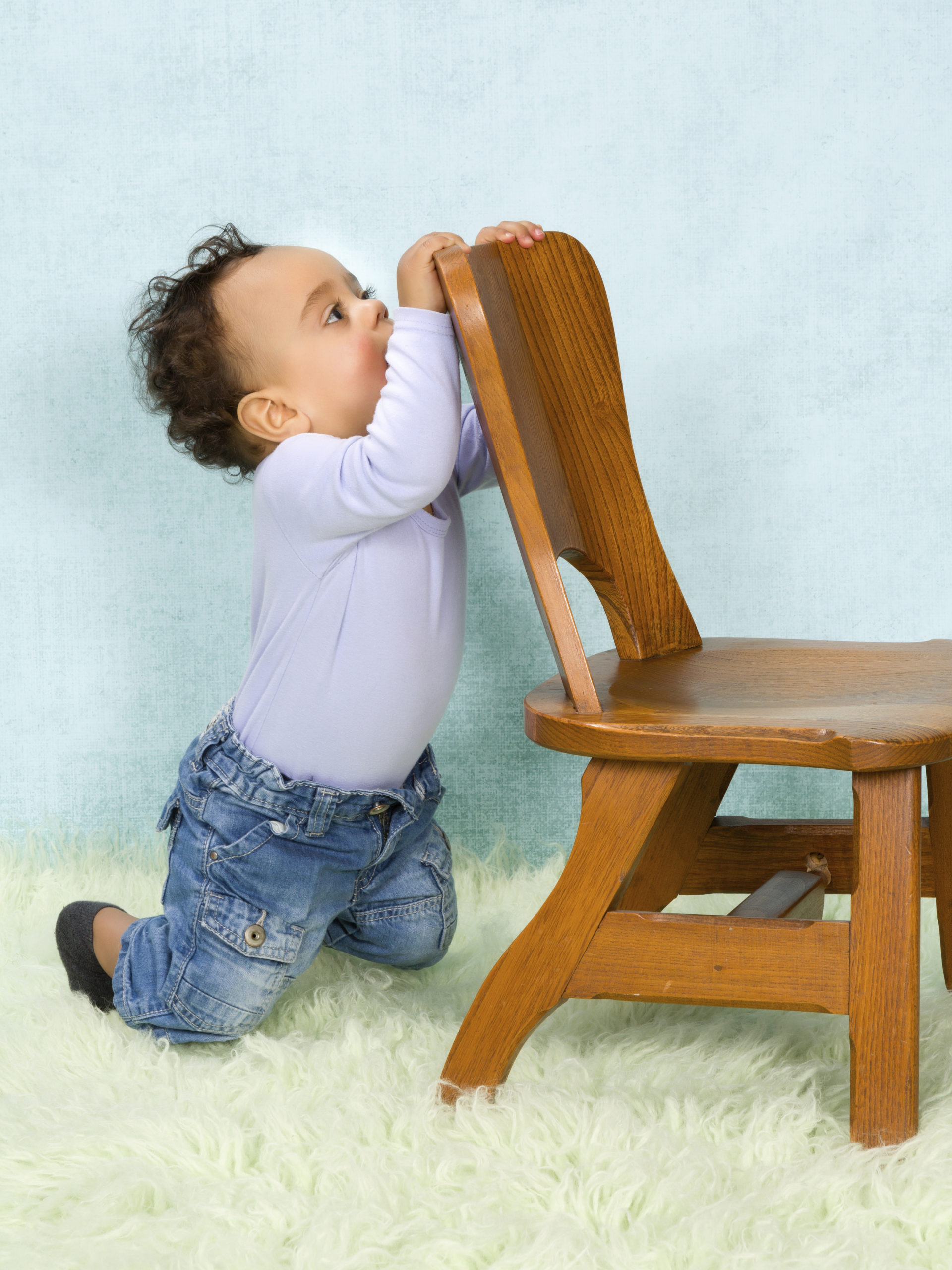
Gross Motor Milestone Series: Standing

StandingStanding is a general term for a skill that encompasses many gross motor milestones. Today we will look at lower extremity weight bearing, standing at a support surface, pull to stand, and lower from stand. Standing activities demonstrate leg and trunk stability, which are necessary for and indicative of a child’s readiness to walk.

Free Time Without Obstacles  

In order to move, your baby has to have the freedom to move. This means daily time spent on the floor outside of car seats, strollers, swings, standers, etc.

Bearing Weight

Weight bearing activities can be started when your baby is able to control his or her head without difficulty, usually between 2 and 3 months of age. He or she should stand with support for 3-5 seconds without the knees or hips collapsing.

  • Hold your child against your chest with their feet on your lap. Gently bounce up and down.
  • Support your child around their trunk with feet flat on the ground. Practice on different textures such as carpet, tile, grass, sand, etc.
  • Encourage splashing, kicking, and pushing against things with the feet.

Standing at a Support Surface

In order to stand at a table, your baby should be able to bear weight on their legs and feet without collapsing.

  • Stand your child at a low table, couch, or activity center while supporting them around the trunk.
  • Slowly decrease the amount of help you provide until they can stand while holding on without your help.
  • Gradually increase the amount, size, and weight of the toys they play with while standing.

Pull to Stand

Make sure your baby can bear weight, get onto hands and knees without help, and stand at a support surface without your help.

  • Practice having your child reach up to a low support surface (stool or the couch with a cushion removed) from a hands and knees position and get into kneeling.
  • Practice having your child reach up to a support surface from sitting and get into a kneeling position. Pull gently on the arms, if needed, to help your child understand what you want them to do.
  • Have your child sit on your lap and pull up to stand at a support surface using their arms and hands.
  • From a kneeling position, bring one leg up with the knee bent and the foot flat on the ground. Assist as much as needed with pushing up to a standing position.
  • Practice the entire movement from sitting and from hands and knees into standing using a higher support surface.
  • Use your child’s favorite toys, bottle, or other motivating object to encourage standing. Place items just out of reach, but far/high enough that your child can’t grab them by reaching from a kneeling position.

Lower From Standing

Your child also needs to be able to get down from a standing position.

  • Hold your child at the trunk and assist them down to sit.
  • Place a toy on the floor and then hold their hand and help them sit on the floor.
  • Use words like “sit” and “sit down and play.”
  • Have your child lower to the floor from standing. You can place a pillow or cushion on the floor to reduce the distance and soften the landing.

If your baby isn’t standing, they might benefit from a physical therapy evaluation. Contact MOSAIC Health & Rehab to schedule a free screen or to set up an evaluation. Check out Gross Motor Milestones: Walking to learn what your child should develop next. To learn more, check out this great milestone moments list from the CDC.  

Is Your Child Ready For School?

Are you wondering why we are talking about school readiness when it feels like school just started? Do you have a child who will be starting kindergarten next fall?  Or have a child in kindergarten? Now is the time to start working on skills that your child will be expected to already have when kindergarten starts.

How do you know if your child is ready for school? The first five years of a child’s life are critical to lifelong development. A young child’s earliest experiences and environments, at home, in school or daycare, and in the community, set the stage for their future development and school and life success. The time that you spend with a child every day can give you information about how he or she is progressing and whether or not your child is ready for school. The goal of school readiness is to help children enter school with skills and behaviors that are necessary for future learning success.

Kids follow a sequence of development. When this development does not progress typically, it can make learning challenging. Follow the simple guidelines to determine if your child will be ready for Kindergarten. Now is a great time to check with your teacher, see how your child has settled into the school year, and make sure they are on track in order to promote the healthiest learning environment. The following guidelines were adapted from the Montana Common Core Standards, which is the curriculum that the public schools are utilizing. Please find more information at: http://opi.mt.gov/Index.html

By the time your child enters kindergarten they should be utilizing a tripod grasp or another functional grasp (as illustrated on page 4) on their writing utensil.

What Should My Child Be Able To Do When They Start Kindergarten?

  • Complete simple puzzles (12 pieces)
  • Write their own name in print
  • Write numbers from 0 to 20. Represent a number of objects with a written numeral 0-20 (with 0 representing a count of no objects)
  • Recognize and name all upper- and lowercase letters of the alphabet
  • Read common high-frequency words by sight (e.g. the, of, to, you, she, my, is, are, does)
  • Identifies/points to three shapes: circle, square and triangle
  • Draws shapes, such as vertical and horizontal lines, circles, crosses (plus sign) and squares
  • Utilize writing and drawing tools with control and intention and hand dominance
  • Utilize child size scissors with control, intention and correct orientation
  • Utilize a tripod grasp or another functional grasp on their writing utensil.

What Should My Child Be Able To Do When Entering 1st Grade?

  • Understand basic punctuation, such as capitalizing first letters of sentences and using periods and question marks
  • Print legibly with spacing and on a line
  • Write in complete sentences
  • Tell time to the hour and half hour
  • Write numbers up to 100
  • Add and subtract within 20
  • Use conventional spelling for words with common spelling patterns and for frequently occurring irregular words

 My child reverses letters, should I be concerned?

Often times, we become concerned if our child is reversing  letters or words (for example: writing b’s instead of d’s, and “tab” instead of “bat,” etc. This is a very common mistake that most beginner readers/writers will make, up to the age of 7. When children are learning to write they frequently have   letter reversals. Often, children will have letter reversals into first and second grade. It is not uncommon or unusual to see children 4, 5, 6 and even 7 years of age making letter and/or number reversals. There may be a need for some concern if a child  continues with letter reversals or mirror reading/writing into and beyond the 3rd grade. If your child is not utilizing these grasps, or if you have other concerns, you may want to have their fine motor skills evaluated by a school or private  practicing occupational therapist.


5 Ways To Prepare Your Body For Pregnancy

Ensure that your body is ready to carry a baby by addressing any pain or problems associated with posture or weakness before pregnancy. Here are some physical therapist (PT) tips to help prepare your body for pregnancy. These will also help to guard against musculoskeletal pain and dysfunction both during and after.

Strengthen Your Pelvic Muscles

To strengthen your muscles, use pelvic floor contractions (commonly referred to as Kegels). This involve gently squeezing the sphincter muscles (rather than the buttocks and thighs). These tightening exercises help prevent leakage when a woman sneezes, coughs, etc. They can also help reduce pelvic pain during pregnancy. However, many women do Kegels incorrectly (perhaps because muscles are too tight and need to be relaxed before strengthening). Doing Kegels incorrectly can worsen conditions such as incontinence, pelvic pain, and even low back pain. This is why it is important to consult a women’s health physical therapist before beginning an exercise program. Physical therapists who specialize in women’s health can instruct women in how to perform these exercises safely and correctly.

Prepare For “Baby Belly” By Focusing On Your Core

Core exercises can help prevent diastasis recti —abdominal muscle separation. As your belly grows, the abdominal muscles that run vertically along either side of the belly button can be forced apart. Think of it like a zipper opening. If these abdominal muscles separate from each other too much, the result can be low back pain, pelvic pain.  Other injuries can also occur as your body tries to compensate for its weaker core. This can also result in the post pregnancy “pooch” many women find undesirable. Some exercises, such as sit ups, increase the likelihood of developing diastasis recti, incontinence, and back pain. Chances are increased both during and after pregnancy. It is important, to work with your physical therapist on the right exercise strategy for establishing a strong core.

Take a Breath!

Learning proper breathing and relaxation techniques from your physical therapist will help prepare your body and mind for a healthy pregnancy. It is important to learn to properly exhale before performing any exercise. With proper technique, your core and pelvic floor muscles will contract automatically, and this will lead to optimal stability and injury protection.

Begin a Regular Fitness Routine

Exercise will help reduce the amount of cortisol (stress hormone) in your body and will boost your muscle and cardiovascular strength—strength you’ll need to carry that extra baby weight. Once you become pregnant, consider engaging in low-impact activities, such as swimming, walking, biking, or using an elliptical machine. Runners should be aware that loosening of their ligaments may make them more susceptible to knee and ankle injuries. Also, when the muscles and ligaments that support a woman’s pelvic organs weaken, the repetitive jarring of running can cause these organs to descend. This is known as pelvic organ prolapse. PTs strongly recommend women wear undergarments that offer pelvic floor support or compression shorts that support the pelvic floor, both during and after pregnancy, to  prevent this condition.

Practice Good Posture

Poor posture can have a major effect on every part of your body, particularly with regard to pain during pregnancy. A physical therapist can evaluate your  posture and suggest muscle-strengthening exercises and    lifestyle education (such as not sitting at a desk for long periods, and carrying grocery bags properly). Establishing healthy posture habits—pre-baby—will better prepare your body for the extra weight of pregnancy and lessen your chances of low back and pelvic pain.

 Reprinted from moveforwardpt.com

Acknowledgement: Marianne Ryan, PT, OCS


Gross Motor Milestone Series: Crawling

Crawling is a major milestone that really allows babies to independently explore their environment. Crawling strengthens the extensor muscles of the trunk and head and increases core stability, which are important for later gross motor skills, such as standing and walking. It promotes shoulder stability, which is important for fine motor tasks such as handwriting and tying shoelaces. It’s a repetitive movement that stimulates brain growth and control of cognitive processes, such as “I see something, I want it, and now I am going to make my body go to it.”

Crawling uses both the right and left sides of the body and promotes communication between the right and left sides of the brain. Throughout the progression of crawling, important vision skills are developing, including the ability of the eyes to work together, to look at an object in the distance (target) and then focus close up (on hands), and is the start of training eye hand coordination.  If your baby isn’t crawling by 9-10 months of age, he or she might benefit from a physical therapy evaluation.

Tummy Time

  • The first step to promote crawling is to practice tummy daily every day, multiple times a day.

Hands and Knees

  • Help your child lift up onto hands and knees, supporting around the trunk. Gradually decrease the amount of support you provide to help up into the position. See if your child can hold the position with help around the trunk, again gradually decreasing the amount of support you are providing. Once your child can maintain this position with minimal support, practice rocking back and forth on hands and knees.

Reaching on Hands and Knees

  • Once your child can rise into and maintain hands and knees without assistance, start to have them lift one hand at a time to reach for a toy. This allows them to practice un-weighting a hand and shifting their weight, which they will need to do in order to move their body forward. Make sure to practice lifting the right and left arms. If your child only wants to reach on one side, gently apply light pressure to the top of that hand in order to force them to reach with the non-preferred side.

Crawling Forward

  • Once your child can get into, maintain, and reach with each arm while in hands and knees, it is time to practice moving forward. Place toys 4-5 feet in front of them. Physically assist by pushing on the child’s feet or guiding their arms. Play chase games, and crawl around, under, and through obstacles.

Crawling Over

  • Place items such as hula hoops, jump ropes, towel rolls, or pillows on the floor and encourage your child to crawl over them to get a toy. Gradually increase the height of the barrier until they can crawl up and over both of your legs when they are straight out together in front of you.

Always make sure to celebrate the small successes, and make it fun! If your baby isn’t crawling, they might benefit from a physical therapy evaluation. Contact MOSAIC Health & Rehab to schedule a free screen or to set up an evaluation. Check out Gross Motor Milestones: Standing to learn what your child should develop next. To learn more, check out this great milestone moments list from the CDC.  

An Insider’s Perspective: Getting Help For a Struggling Child


“I’ve been a pediatric OT for 8 years.  I can handle parenting. Even a tricky kid would be no problem for me,” was my general line of thinking. Then Judah came along. We longed for my son, and his arrival into our family four years ago has brought so much joy. Judah has developed as a typical child in so many ways. He is cheerful, creative, and affectionate, loves diggers and animals, and has a blast playing outside in the snow.

He’s a Live Wire

When he was born I was home full-time and as wholly devoted as any first time mom. He was well adjusted – sleeping and eating well, bright eyed, and cheerful.  There were occasional hints of the storms to come, the hardwired personality making itself known. As a newborn a mere 6 hours old, he fussed in my husband’s arms. We were not able to calm him, even when we tried walking, swaddling, or shushing.

My husband paced the floor and said, “He’s a little temperamental. I think he’s going to be a live wire.” “How can you possibly know that, he’s six hours old?”  I asked.  At four months old he wanted to stand, and I wanted him to sit.  He straightened all four limbs, looked my husband right in the eyes, somehow stamped one foot, and screamed one shrill scream of defiance. “I want to STAND” his four month old self clearly asserted.

Observing the Struggles

Judah began to scream for his milk, scream for a book, and scream to be out of his car seat. His language skills developed early. Even in the presence of two attentive parents and a wide, descriptive vocabulary, he always went for the scream and demand option first. Tantrums and screaming almost  always included Judah running to his bedroom and slamming his door, like a teenager filled with angst, and occurred over most any situation. Then we added another baby. The screaming intensified almost overnight in direct connection to the new arrival of Judah’s little brother. Now along with the screams came physical aggression, throwing, and hitting.

I had already been trying my OT tricks, the ones that help children who can’t seem to self calm or regulate emotions. I offered a wide variety of calming sensory input, I tried a picture schedule with lots of warnings of transitions, and I used a timer. We stayed on a regular schedule with hyper vigilance to hours of sleep, limited TV, turned down activities that might upset him, and limited sugar. I went down the rabbit trail of food allergies being the cause of his struggle to manage his intense emotions and tantrums.

This included pouring my heart out to family and friends, trying their suggestions but not finding any magical cures. I took parenting classes and ascribed to various parenting styles trying to find one that fit his temperament and needs. Even with all this,  I found the joy of my little boy slipping away, his needs and  demands exhausting my ability to be present, loving and connected. I started struggling to find things I liked about my little boy. Yes, I loved him, but liking his company – not so much.

The Pains of Parenting

The “maybes” and “what ifs” plagued me. What if there is mold in the house? Maybe he has autism? Maybe he ate some dairy?  What if he has oppositional defiance disorder? Maybe I’m not such a good parent after all?

That one final statement is what started to plague me most of all. Maybe I’m not such a good parent after all. It was heartbreaking to pour myself into this person, this relationship and watch him be so upset with such regularity and no apparent cause, no medical diagnosis. Even in the presence of loving parents who were trying so many tricks and strategies, nothing was really changing his or my own sense of well being. It became exhausting on all fronts. The emotional temperature in our home was high. I was always stressed, on edge, and weighed down with guilt. I found myself losing my temper in ways I never thought I would before I was a  parent, and my husband was exhausted helping to care for a new baby and trying to keep Judah and me somewhat in harmony.

You are Not Alone

Finally, I hit my wall and a counselor friend of mine suggested I talk with a colleague of hers who specializes in play therapy for young children and their families. I called her in tears  saying “This isn’t what I thought it would be,” “I can’t help my own child,” and “He’s just not ok and neither am I.”

How Counselling Helped Us

First we began weekly visits without Judah. I started telling her our story, of Judah’s recent infractions at school, his recent statements of wanting to hurt his brother, and the two hour bedtime horror that unfolded every single day. She noticed in our story that we had moved quite a few times…five times in his four years of life, actually. The counselor noticed that I went back to work when he was 8 months old, at the height of a child’s development of separation anxiety. She commented that a lot of personality is hard wired and it sounds like I got handed a more intense kiddo than some.

Our counselor thinks that Judah might have separation anxiety and has taught me that when younger children act angrily or aggressively it is often coming from a place of deep sadness or anxiety. That had NEVER occurred to me!

A New Perspective

Going to counseling is giving me a whole new perspective on parenting. Not parenting in general, but parenting MY KID with his unique personality and needs that have arisen based upon his experiences in life as well as my own. She gives me strategies to support him through his anxiety. I try them at home and let her know how it went the week before. She helps me breakdown our problem areas (bedtime, mealtime, transitions, etc.) into step by step increments to identify where the problem is and provides some problem solving strategies to simplify these areas in order to decrease conflict.

The counselor also highlights some key points of typical emotional development in children Judah’s age so I can see what is normal and what is coming from anxiety for him. She is helping me break down my parenting strategies and giving me perspective on how I’m a part of the problem, which is empowering me to be a part of our solution.

Starting to See Some Changes

Not all children respond the way Judah is to this counseling, but the difference in my home because of this support is NIGHT and DAY! Judah is screaming only occasionally, at a rate that seems typical and appropriate for a four year old  trying to navigate a complex life.  I have someone coaching me on what to say and how to help him when he expresses anger that makes him want to hurt someone and he is no longer lashing out physically. He is affectionate, cheerful, singing, and kind again. He has changed in ways I didn’t know he could…and so have I.

I feel more confident as a parent. I am starting to work through the grief I am experiencing that this kid, my kid, didn’t turn out exactly as I had expected, and I am finding a calm presence that is flowing over onto Judah. Finally, I have the  emotional energy to support him through meltdowns when they happen because I’m not chronically exhausted.

I asked our therapist how to know when counseling would be good for a child or family. She said, “If what is going on, either emotionally or behaviorally, is interrupting the enjoyment and function of daily life, at any age, then counseling can be helpful.”

Another counselor in the community had this to say, “My focus in counseling tends to be aimed at strengthening relationships and increasing understanding between parent and child.  When parents understand clearly what is motivating their child, the child will feel validated and then behavior can be addressed together, with both parent and child participating in the solution.”

Possible Resources

The Gallatin Valley has many LCPC’s or Licensed Clinical Professional Counselors, as well as LSW or Licensed Social Workers who provide counseling for children and families.  These professionals are trained in a variety of counseling techniques. This way they are able to help children and families in the best ways possible. Sometimes the reason to seek counseling is obvious, such as divorce, death of a loved one, bullying, grief related to a childhood medical diagnosis, or other noticeable and traumatic events. But sometimes, it isn’t so obvious, as in my situation.

If you think that counseling could help you, ask your family physician for names of people to talk to or call MOSAIC Rehabilitation for a list of counselors in the area who    specialize in working with children, teens, and their families. Next, call the counselor and explain your situation and concerns. Ask if they have experience working with families like yours. Make sure you feel comfortable with that person and that their personality will go well with that of you or your child. Most important, don’t be afraid to talk with more than one person to find a good fit.

Your counselor can also help you find other professionals that can help support your kiddo, including therapy services like physical therapy, occupational therapy, or speech therapy or referring out for further testing needs or other areas of support.

Counseling, from my perspective, is another great tool to add to the tool bag as we do our best to raise healthy and happy kids, no matter their circumstance.


 

Building Play Skills for Healthy Children and Families

Play can be defined as “any spontaneous or organized activity that provides enjoyment, entertainment, amusement, or diversion” (Parham and Fazio, 2008, p. 448). Play is one of children’s major jobs—how they occupy their free time and learn. Building play skills is an important activity for your child because play helps to facilitate positive growth and development.

Physical health, social and emotional well-being, and positive mental health are also promoted through play. When a child is building play skills, they experience new ways to solve problems and learn skills needed to become a healthy adult. Research has shown that children who participate in play frequently grow quickly, experience higher achievement in school, and develop healthy habits for adulthood. A study of 11,000 third graders found those who participated in more than 15 minutes of recess per day behaved better in the classroom and were more likely to learn than their peers who had little to no recess opportunities. (Barros, Silver, & Stein, 2009).

Using daily routines and activities during the day to build play skills encourages the happiness and joy that can be experienced through play. And, simply allowing children to be playful can enhance their health and well-being.

How can Families Build Play Skills?

Early Childhood

Play teaches infants, toddlers, and preschoolers about their bodies and about the effects of their actions on the world around them. Play promotes growth and development through movement and exploration. Family members are a child’s first playmates.

  • During their first few months, babies enjoy colorful mobiles, rattles, vocal play such as talking and singing, and games involving moving their arms and legs. Encourage your baby to participate while lying on their back, belly, side, or while supported on your lap.
  • As babies learn to reach, grasp, and sit on their own, they will enjoy mirror play, balls, and toys that involve squeezing, stacking, and pulling apart. Babies also enjoy interactive games like peek-a-boo, music, and books. Water play with toys that float and plastic letters to stick on tile walls provides bath time fun.
  • Since babies enjoy and learn through putting toys in their mouths, make sure they play with toys that are age specific and are made without small parts.
  • As children learn to walk and run, they enjoy climbing, chasing, hide-n-seek, and pull toys.
  • Toddlers develop hand skills by dropping shape toys into slots and scribbling with crayons. They also  enjoy books and toys that make sounds. They begin to imitate by using, for example, a toy telephone or hammer.
  • Imitation and pretend play increases during the preschool years, through use of dress-up, puppets, and toy cars and trains. Preschoolers enjoy construction games such as building toys and puzzles, which further build play skills and develop their coordination. Playground time and riding toys encourage large muscle movement. Playing with materials with different textures, such as finger paints and sand, allow sensory introduction. Games during the preschool years teach turn-taking and getting along with others. These activities also help children develop language skills.

Elementary School

The elementary school years are an important time for learning to play by rules and participating in cooperative activities such as sports teams. Motor skills are being fine tuned, and there is an increased interest in developing hobbies. Play often serves as a way of developing friendships and expressing one’s unique personality. Finding a balance between formal play (e.g., participating on a sports team) and informal play (e.g., participating on the playground) allows for play time to be both active and creative.

Try these ideas to build skills and expression:

  • Participate in board games and sports activities with your child; this helps your child to learn to follow rules.
  • Have various craft materials available to spark creativity and interest.
  • Offer options for extracurricular activities that include both physical and creative exploration (e.g., sports teams or performing arts experiences).
  • Provide play options that include both structured and less structured choices (e.g., being on a school team or playing soccer in the yard with neighborhood friends).
  • Encourage your school to support recess as a necessary part of every child’s day. This is a good time for physical movement that can promote learning and positive behavior.
  • Like recess, active play before homework time can prepare your child for learning.
  • Don’t forget to keep play activities fun! If you lose that element, it is no longer play.

Middle School

The early teen years mark a time of exploring social relationships. This is a teens’ form of play. Teens tend to like group activities, such as spending time with friends, listening to music, talking, and going to the mall. This time with friends allows them to improve social, movement, and mental skills; gain an understanding of themselves as individuals; and practice new skills in different environments without continuous parental supervision. These opportunities can promote a sense of wellbeing. Young and older teens also enjoy after-school activities, such as clubs (drama, music, art, athletics) and work (volunteer and paid).

  • Encourage your child to join school and community-based clubs and after-school activities.
  • Participate in leisure activities with your teen, such as table tennis or biking, to help strengthen family ties and offer opportunities to build communication.
  • Ask questions about your child’s preferences in movies or music to indicate your interest and to spark conversation.
  • Consider your own habits and routines of leisure and whether they include physical activities and model a balanced lifestyle of work and play. You are a role model for your teen.

High School and Beyond

During the high school years, play promotes cooperation and opportunities for teamwork. Through play, older teens are able to get to know themselves better and pinpoint their interests and their strengths. As school and social pressures increase at the high school level and  beyond, leisure activities can reduce stress and offer a sense of belonging and a chance to develop their goals.

  • Encourage your teen to balance homework with leisure time to promote a healthy lifestyle that addresses both mental and physical wellness.
  • Encourage limited screen time (TV, computers, and iPod/iPhones) and increased physical activity to help prevent or reduce problems that are associated with obesity and depression.
  • Find a good fit between the demands of the leisure activity and the skills and interests of your teen. For example, depending on your child’s personality, physical abilities, and interests, he or she may prefer more physically demanding activities like swimming, whereas other children may prefer debate or drama clubs that challenge verbal and other cognitive skills.
  • For all age groups, offer healthy, balanced meals as the fuel needed for physical activity.
  • To prevent injury for all age groups, be mindful about the use and proper maintenance of appropriate safety equipment, such as helmets for biking. Know the signs of concussions. Encourage stretching before and after vigorous exercise.
  • Low-cost, easily accessible leisure pursuits such as chess or basketball offer lifelong participation through community leagues and recreational centers.

Play shouldn’t stop in childhood. It continues to help build coordination and strength as well as creativity and social skills in all ages. Play also helps to develop emotional well-being and increases a child’s ability to explore, problem solve, and create.

How can Parents Help Early with Building Play Skills?

  • Encourage sensory rich play by using balls, sand and water toys, slides, swings, finger paints, and magnets. During sensory play, children use their senses to incorporate smell, touch, sound, vision, and movement.
  • Encourage manipulative play, such as using play dough, LEGOs, and board games. Toys such as puzzles, pegboards, beads, and lacing cards help improve the child’s eye–hand coordination and  dexterity
  • Promote imaginative or pretend play with things like dolls and stuffed animals, toy furniture, puppets, and telephones. Pretend play encourages creativity and role playing and provides an opportunity to rehearse social skills.
  • Choose toys that are appropriate to the child’s age and/or maturity level. They do not have to be expensive or complicated to be beneficial. Common objects, such as pots and pans, empty boxes, spools of thread, shoelaces, and wooden spoons are readily accessible and encourage children to use their imagination.

How can Occupational Therapists Help with Building Play Skills?

  • Help modify the environment or adapt toys to provide optimal sensory input without overwhelming the child.
  • Recommend toys and play activities that provide the right amount of challenge for the child, so they learn while having fun. The occupational therapy practitioner can also recommend ways to build on the child’s strengths and abilities.
  • Offer play opportunities that encourage turn taking and problem solving. Consider family routines and priorities when recommending play strategies. Observe, identify, and develop play strategies that promote a healthy lifestyle and relationships.

If you have a newborn and need ideas about how to start building play skills from the start, check out MOSAIC’s Infant Play Activities.

References
  1. Barros, R. M., Silver, E. J., & Stein, R. E. K. (2009). School recess and group classroom behavior. Pediatrics, 123, 431–436. Retrieved March 22, 2011, from http://pediatrics.aappublications.org/cgi/content/abstract/123/2/431
  2. Parham, L. D., & Fazio, L. (2008). Play in occupational therapy for children (2nd ed.) St. Louis, MO: Elsevier.