Paradoxical Vocal Fold Movement: How Can Speech Therapy Help?

Paradoxical vocal fold movement (PVFM) is inappropriate closure of the vocal folds when inhaling and/or exhaling. Vocal folds close suddenly when they should remain open. PVFM may occur in both children and adults. People experiencing PVFM feel like they are breathing through a narrow straw. They struggle to get air in and may feel dizzy, panicked, or faint. Symptoms can be very similar to asthma but PVFM is not asthma.

Paradoxical Vocal Fold Movement Triggers

PVFM is most often triggered by laryngeal irritants such as:

  • Smoke
  • Fumes
  • Vapors
  • Dust
  • Allergens
  • Gastroesophageal reflux (GERD)
  • Post nasal drip
  • Cold temperatures
  • Upper respiratory infection.

It may also be exercise induced, which is why it is frequently confused with asthma. A wheezing noise (stridor) that occurs on inhalation accompanied by tightness in the throat is indicative of PVFM as compared to wheezing on exhalation and tightness in the chest, which is typical in asthma. PVFM caused by irritation to the larynx is very often responsive to speech therapy, and in most cases, involves only a few sessions of treatment with home exercises for breathing. Therapy focuses on identifying triggers and learning techniques for breathing and laryngeal relaxation.

In rare cases, PVFM may be neurological in origin. PVFM that is neurological in nature presents with persistent symptoms rather than sudden breathing attacks. PVMF that is due to neurological causes requires medical management and does not typically benefit from speech therapy.

Stress and anxiety are other causes of PVFM, but it is important to rule out irritants as a cause. Treatment focused on stress or anxiety will not be effective if laryngeal irritants are not first resolved. Stress or anxiety induced PVFM often responds to treatment as well. Treatment will focus on education and relaxed throat breathing. A referral to psychology or psychiatry may occur in order to effectively manage the stress and/or anxiety causing PVFM.

Words to Work On and Words to Wait On

If your child is just beginning language therapy, you might have some questions about how their speech therapist is choosing what words to work on. With all the words out there that can help children communicate better, which ones are the most important to focus on first? After reading this you should have a better idea about words to work on and words to wait on when you work with your child at home.

Functional Words Versus Academic Words

First, lets talk about different types of words children can use. To make this easy, we will just divide them into functional words and academic words. Functional words help to get immediate needs met. Academic words help to build knowledge of a specific topic or domain.

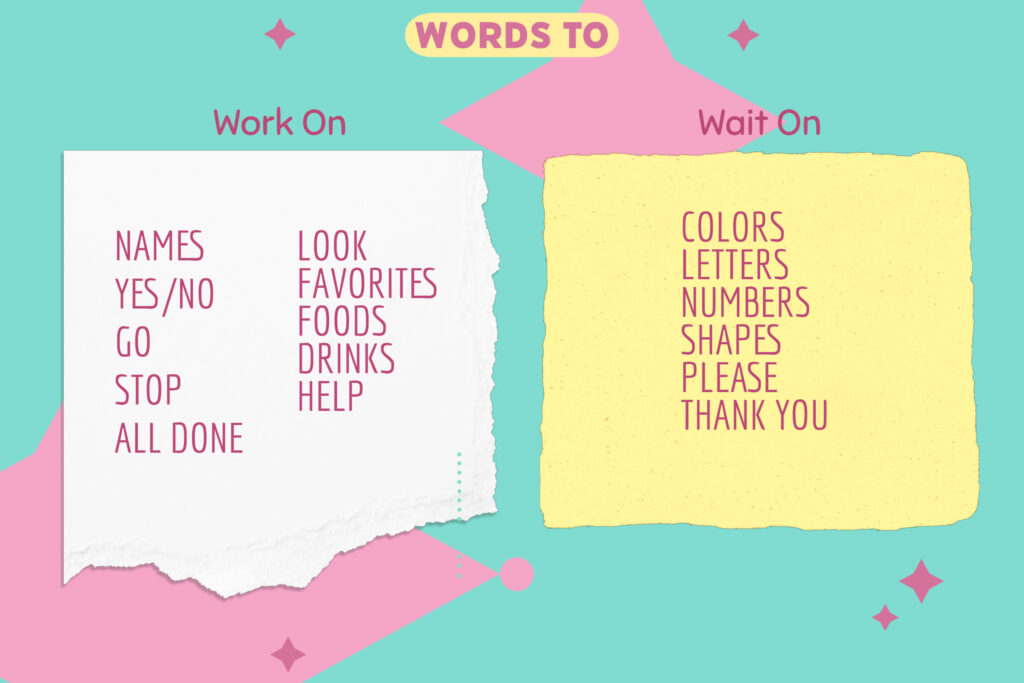
Teaching functional words first will help children to express themselves more successfully. Once children learn the words to get their immediate needs met, you will likely see less frustration and behavioral outbursts. Functional words may include names of immediate family members or caregivers, yes/no, names of foods and drinks, favorite objects and actions. They may also include words such as: go, stop, all done, help, and look. These words will help children communicate their wants and needs and make meaningful requests.

Academic words include: colors, numbers, letters, shapes, etc. I also include please and thank you on this list. Although please and thank you are manner related and not specifically academic, they do not serve to meet a child’s immediate need. Academic words are useful, but if your child is just beginning to talk and learn language they are not as helpful in making your child a successful early communicator.

How to Teach Functional Words to Work On

It is easy to feel overwhelmed when your child is beginning therapy. If you are starting the speech and language therapy process with your child, please know you should always feel comfortable asking your therapist any questions you may have.

When teaching functional words, the goal is not just to get your child saying the words. Children have to understand words before they will begin using them to communicate. So, when you think about words to work on, the goal isn’t just speaking or saying the words. I like think about words for objects or actions your child loves and uses on a daily basis. These may be different for each child. Some examples may include: car, shoes, ball, eat, banana, stop, go, push, etc.

Label these words at home. If you see these objects or complete these actions within the community label them there as well. For example, “You want to eat,” “You are eating a banana,” “I see the banana,” etc. Functional words can also be modeled using sign language. As your child becomes more familiar with these functional words, you can start to encourage your child to use a sign or verbal word approximation to request these words.

Speech and Language Kids also has some really helpful information about how to help your children learn to be functional communicators.

words to work on

Each Child is Different

It is important to remember that every child is different. This means children learn differently too. Some children may gravitate to using academic words, and that is ok. You can then use these words to help build a more functional vocabulary. Just remember, when you are working with your child try to help them learn. Use words that will help them express their wants and needs as much as possible. Once your child can get their needs met, the focus can shift to more academic vocabulary.

It may be helpful to check out our blog on prelinguistic development to see if your child is ready to start moving forward with verbal language. If you have questions about your child’s language development, call us today at (406) 388-4988.

Follow Your Child’s Lead and Promote Language

Children learn to communicate gradually by spending time with the various people in their lives. Communication is two people sending messages to one another. This form of communication might be in different forms, including body language, gestures, signs, simple sounds, babbling, words, or vocalizations closely approximating words. Children learn these forms of communication from observing others. They are more likely to be engaged and motivated to communicate when the activity or topic of conversation interests them. Follow your child’s lead to increase their interest in communicating with you.  

Following your child’s lead is simple. When they are playing, join in and play with them. Even if they are not interacting with you, imitate their play. If they are banging toys together, bang toys together alongside them. If this attracts their attention, they might hit their toys together again and wait for you.  An interaction has begun!

Another way to gain a child’s attention is to use fun sounds and words. Examples include:

  • “Vroom vroom” or “Beep beep” when playing with cars
  • “Chugga chugga choo choo” when playing with trains or when you see a train while driving
  • “Pop” when playing with bubbles
  • Animal sounds when playing with animal toys

Simple Actions to Follow Your Child’s Lead

  • Imitate – Do what your child does. If they bang their hands on the floor, you hit your hands on the floor. If they make a babbling sound, you make the babbling sound too. Imitating lets your child know you are interested in their actions and sounds.  
  • Interpret – Observe what your child may be trying to communicate, and interpret it in a simple phrase. If your child points to the candy cupboard, it is obvious what they are trying to communicate to you. Put this communication into words for them by saying, “You want candy.” This model will help your child learn to say those words eventually.  
  • Make a comment – Use short, grammatical sentences to comment on what’s happening throughout the day. For example, if you’re driving and hear a train, you could say, “I hear the train. The train is loud.”
  • Follow through – When your child makes a request, it is important to follow through so they know that their communication has an effect. For example, if your child hands you their shoe, imitate their words with correct pronunciation or interpret by commenting and helping them put their shoe on. If the request is unreasonable, let your child know you understand and explain why they can’t get what they want. For example, “I know you want candy, but we can’t eat that right now.”

Three Comments to Every Question

It is natural to ask a question when we want to communicate with one another. Still, in general interactions, we don’t usually ask someone five questions in a row. Subsequent questioning can cause a child to shut down and disengage in a communication interaction. Accept the challenge to give at least three comments to every question you ask your child. Remember, if you are commenting on a child’s interest, they are probably listening intently. They may look at you or communicate back to tell you they heard you. For more tips on increasing communication, check out Is My Child Ready to Start Talking?

References
  1. It Takes Two to Talk: A Practical Guide for Parents of Children with Language Delays, Elaine Weitzman

Prepping for Pumping: Supporting the Return to Work

Returning to work is a huge transition for many mothers. The addition of pumping can be both emotionally and physically challenging. Will baby take a bottle? What will my boss think? Will I lose my supply? If any of this sounds familiar, you’re not alone! Everyone’s experience will be different, but as Speech Language Pathologists and Certified Lactation Counselors, here are some of the steps our feeding specialists suggest. These will help you ease your way back to work feeling more confident and less anxious.

Firstly, know your rights. As of 2010, portions of the Affordable Care Act require employers to provide you reasonable breaks and a private space to pump. Legally, this cannot just be a bathroom. You may take these breaks multiple times throughout your shift until your baby is one year old (though many employers are accommodating beyond this).

Then, be upfront with your boss. If you know you’ll be pumping, consider starting this conversation as part of your maternity leave meeting. That way, there’s already a plan in place and less suspense for your return. Let them know how often you’d like to take a break, how long you feel is appropriate, and where you’d like to store your milk. Remember to discuss any sanitizing or washing needs. Don’t sell yourself short – 15 minutes is often not long enough to set up, express milk, and tidy. Similarly, trying to please your boss by pumping less often will likely reduce your milk supply. Be upfront and honest.

Pumping Logistics

Now let’s get to logistics. You’ll need an appropriate pump for expressing milk at work to be effective in supporting your goals. Most insurance providers cover electric pumps at little to no cost. While hands free models are hitting the market hard, proceed with caution until you feel confident in your typical supply. Often, these types of pumps are less powerful and yield lower milk output. Additionally, get to know your flange size. Most woman are using a flange much too large, which can cause pain, reduced milk flow, and be less efficient for pumping. Pumps can be confusing and frustrating. A lactation provider will be able to support you in selecting a pump that fits your needs, budget, and preferences.

You’ll also want to make a schedule. If your infant is nursing at home every 2-3 hours, consider pump breaks at similar intervals to make up for those missed feeds. Later on in your back-to-work journey, you may be able to space these out further. But we want to do everything we can to protect your supply in those first precious weeks or months. What might that look like?

What Does a Pumping Schedule Look Like?

Let’s say Sarah works 9 am to 4 pm. She nurses her 4 month old daughter, Hattie, at 8 am before they leave the house for daycare drop off. Sarah pumps for 25 minutes at 11 am, again at 1 pm for 30 minutes, then leaves work at 4 pm and nurses Hattie when they arrive home at 4:15pm. A standard recommendation would be to send about 1 to 1.5 oz of milk per hour that you are gone. So, Sarah sends Hattie to daycare with two 4 oz bottles. Now, clearly, many babies do not run by this specific of a timetable. But as you practice and get in the rhythm of pumping, your childcare days become more predictable.

Storage guidelines

It’s always important to remember appropriate storage guidelines. A quick review per the CDC:

  • Freshly pumped milk is safe at room temperature for up to 4 hours, in the refrigerator up to 4 days, and frozen up to 6 months (up to 12 months in a chest freezer).
  • Thawed, previously frozen milk is safe at room temperature for up to 2 hours, in the refrigerator for 1 day, and should never be refrozen.

Finally, introduce and practice with a bottle early. Give yourself time to find baby’s preferences before your first day back. If you’re still having difficulty, schedule a consult with a feeding specialist, or check out Help! My Baby Won’t Take a Bottle.

Going back to work can be hard, but our community is here to help! Lactation consultations are great tools to establish a plan of action. We’re here to support you all along the way. Best of luck and congratulations.

Resources

Study Tips for Students with Language Learning Disorders

Studying and homework are not preferred activities for any student. However, they are skills students need to learn in their early school years. This is especially important for students with language learning disorder or dyslexia. The following study tips will make studying easier and more effective.

Study tips

  • Firstly, know what the test will look like. Will the test be true/false questions, multiple choice questions, short answer, or essay? The test format will determine how much reading and writing is needed. An essay will certainly require much more writing and recall of information than, for example, a multiple choice question.
  • Allow extra time. Do not wait to study the night before an exam. Instead, begin studying on a Monday for a Friday exam. A student who reads more slowly than typical will require extra time to cover test material. Extra time may also be needed because a student requires a great deal of repetition to recall facts, dates, definitions, etc. Spaced repetition strategy is an effective means to facilitate recall of such information. The idea is to space out short study sessions focusing on one topic and progressively increasing the time before recalling information. For example, read a definition, restate the definition immediately, then at one minute, five minutes, 10 minutes, etc.
  • Establish a study schedule to review course work frequently. A night without homework should not be a night without homework. Use non-homework days to review concepts used in school, especially if a subject is difficult. Review can be a few minutes studying math facts, spelling words, or definitions. Break material down into smaller chunks and review frequently using spaced repetition.
  • Get study material in advance. Most teachers have their lessons planned in advance and are happy to make study material available to students. This is a good time to practice self-advocacy.

Make it Easier

  • Make flashcards. Flashcards break material down in to smaller units, making information more easily accessible. This is more effective than reading an entire paragraph over and over again. Make flashcards while reading. This is faster and more accurate than trying to make the cards after reading an entire paragraph.
  • Ask parents to help with reading. The purpose of studying is to learn the information, not necessarily to improve your reading. Improving reading is a good goal, but not at this time. The focus is to understand and acquire the knowledge needed to do well on a test.
  • Remove distractions. Make the area as study friendly as possible by having needed materials available so that there is no temptation to get up and get something every few minutes. Have a snack before beginning and certainly turn off your cell phone and place it out of sight.

Studying is not enjoyable but is an essential skill for academic success. The idea is to study smarter, not longer, by using study techniques and studying regularly.

Vision for Preschoolers

From the ages 2 to 5 children will be fine tuning the visual abilities gained during infancy. They will also be developing new ones. Preschoolers use their vision to guide learning experiences. Basically, every experience provides an opportunity for growth and development. Play activities of stacking blocks, ball play, coloring, drawing, and assembling lock together toys are helping to develop visual skills. They address eye-hand body coordination, fine motor skills, and visual perceptual abilities which are foundation skills of reading and writing.

Ensuring preschoolers’ vision is developing normally will help provide a good “head start” as they enter school. Parents and caregivers need to be alert for the presence of vision problems during these preschool years. Well child checks typically include a vision screening by the child’s doctor/pediatrician. However, these screenings are limited and can miss vision problems. As a result, “passing” a vision screening can provide a false sense of security. They may not assess how well a child can focus or how well their eyes work together.

It is recommended that between the ages of 3 and 5 children have a thorough optometric eye examination to be sure vision if developing properly. With today’s equipment, a child does not need to know letters or how to read to have their eyes examined.

As parents and caregivers, the playtime that is spent with your preschooler can help to develop vision. Below is a very basic, simple list of activities that can be done to help develop visual skills.

Simple Activities that Develop Visual Skills

  • Throwing and catching bean bags or balls
  • Reading aloud and letting the child see what you are reading
  • Drawing and coloring using chalk, finger paints, and crayons
  • Block play and puzzles
  • Simple memory and matching games
  • Outdoor activities including swinging, spinning, and rolling

Preschool aged children generally will not verbalize complaints about their eyes. Therefore, the list below includes some things to watch for that may indicate a vision problem.

vision problems in Preschoolers: Warning signs

  • Sitting close to the TV or getting close to books/drawing activities
  • Squinting
  • Tilting their head
  • Covering an eye
  • Frequently rubbing their eyes
  • Short attention span for the child’s age
  • Turning of an eye in or out
  • Sensitivity to light
  • Difficulty with age level eye hand coordination tasks
  • Avoiding age level activities of puzzles, coloring, or other detailed activities

Despite being aware of what to look for and providing vision rich activities, children may still miss a step in vision development. A comprehensive visual examination between the ages of 3 and 5 is important to detect and address any concerns before the child begins school. You can also learn more about vision for younger kids and babies here. For more information regarding vision, check out these eye health tips.