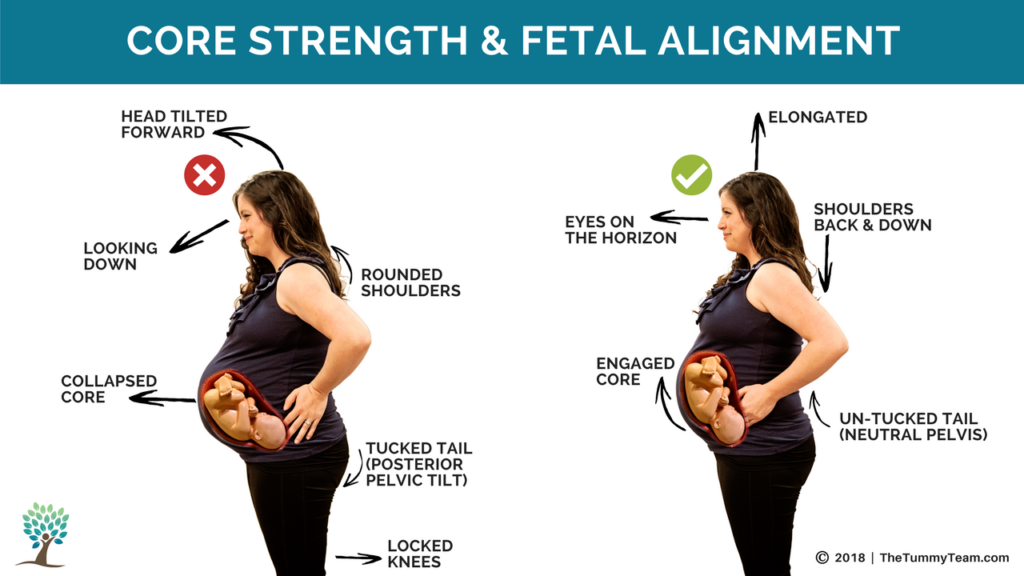
Posture Throughout Pregnancy is Important

Maintaining good posture throughout pregnancy is challenging, but your body will thank you if you do. Good posture can help limit common side effects in pregnancy such as headaches, pelvic girdle pain, shoulder pain, as well as improve respiratory capacity.

During pregnancy, a woman’s body weight increases by 15 to 25 percent; increasing the demand on tendons, ligaments, and joints. Additionally, hormones, such as relaxin and estrogen, loosen the ligaments and increase risk of injury. As the uterus and breasts grow, the body’s center of gravity shifts towards the front. The pelvis is tilted simultaneously, and the lower back curvature increases. All these changes require your muscles to adapt. With adequate strength, the body can better stabilize your posture and reduce risk of pain and injury with daily activities.

posture throughout pregnancy

Tips to Help You Maintain Good Posture Throughout Pregnancy

  • Look forward, elongate your neck, and tuck your chin slightly.
  • Pull your shoulders down and back.
  • Engage your core by lifting your belly button.
  • Slightly bend your knees whenever standing to promote neutral pelvic alignment and reduce knee pain.
  • See a women’s health Physical Therapist and/or prenatal exercise specialist.

Your body’s innate wisdom will carry you through, but specific strength training can go a long way in limiting discomforts associated with pregnancy. For more specific ideas about how to maintain your posture throughout your pregnancy, click here.

How Can an Evening Routine Help?

Most families practice a morning routine, as it helps to get your family moving and out the door on time. However, evenings tend to be more relaxed. But, would your family benefit from ENDING the day with an evening routine? Ending your day with a routine can be helpful for children to gain independence, regulate energy levels, and develop important skills. In general, having routines help build executive functioning skills in children.

Executive functioning is a precise blend of motor, sensory, and communication skills that are very critical to our daily decision making skills and our behaviors. Memory, mental flexibility, and control are the powerhouse behind executive functioning, and we can begin learning these skill sets at a very young age.

In addition to refining executive functioning skills, evening routines can help in other ways.

How an Evening Routine Helps

  • Promote self-control – balancing activities and utilizing time efficiently.
  • Reducing anxiety – each day will have some predictability.
  • Increase confidence and independence – kids learn to manage tasks on their own.
  • Regulate energy levels – helps in winding down after a busy day.

So, if an evening routine is something you would like to initiate within your home, there are some things to think about.

Things to Keep in Mind

  • Think about what each child needs to do every night, and remember that routines vary from person to person or child to child. Therefore, it is very important to find what works for each individual person and stick to it.
  • Make time for activities of daily living. A successful routine will incorporate and prioritize what MUST be done every night. Consider such things as snack, chores, homework, and bedtimes.
  • Include hobbies and preferences. Hobbies and preferences are essential for development and assist in creating a foundation for healthy habits. Some activities to consider include: brushing teeth, dance class, baseball, etc.
  • Always be positive and encouraging. Make sure that there is plenty of time for fun, otherwise motivation to engage and participate is limited. Make sure to include play time outside.
  • Pay attention to how your child responds. Make sure that your child is successful with the routine. Don’t dwell on what wasn’t completed. Make adjustments as needed until you have found a routine that works. Also, provide praise for accomplishments.
  • Be open to change. If your child seems overwhelmed or disengaged, then talk to them about what is happening in their daily schedules. Make sure that your child is enjoying the activities that they are participating in.

Starting something new always comes with its challenges and difficulties, but it is extremely important to keep in mind the long term benefits. Be patient. The routine that works for your child may not be the routine you envisioned. And that is perfectly OK! Establishing a new routine or habit takes time, consistency, and patience. The long term effects will be worth all of the hard work in the end and for years to come.  

Orthostatic Hypotension

Orthostatic hypotension (OH), also known as postural hypertension, is a type of low blood pressure that occurs when standing after sitting or lying down. Symptoms can be mild and brief or more severe and chronic. Symptoms vary from the sensation of dizziness or lightheadedness to loss of consciousness, depending on the severity. Mild periodic symptoms can usually be attributed to dehydration or a period of bed rest, and are easily treated. More severe symptoms should be evaluated by your doctor as persistent OH can be a symptom of an underlying medical condition.

Symptoms of Orthostatic Hypotension

Dizziness or lightheadedness is the most common symptom of OH. Symptoms that are more concerning include blurry vision, weakness, fainting or losing consciousness, and confusion upon standing. Keeping track of when and how often symptoms occur is important. Mild periodic lightheadedness, for example, may be of less concern to your physician than feeling faint while driving. Talking with your physician is important because complications from OH can be serious, especially for the geriatric population. The most common is injury from a fall due to dizziness or fainting. Additional complications include stroke due to reduced blood flow to the brain and irregular heartbeat.

OH occurs because of a drop in blood pressure when standing. Gravity allows blood to collect in our legs or abdomen resulting in less blood flowing back to the heart. When this occurs our body signals our brain to make our heart pump faster which stabilizes our blood pressure. When this process is interrupted, OH occurs.

Conditions that may Cause OH

Dehydration. Dehydration reduces blood volume, and thus, blood pressure. Drinking an insufficient amount of fluids, fever, vomiting, severe diarrhea, and excessive sweating all lead to dehydration.

Eating meals. Some, not all, older adults have lower blood pressure after eating a meal.

Cardiac problems. Very low heart rate, heart valve problems, and heart attack prevent the body from pumping more blood upon standing.

Neurological problems. Neurological disorders such as Parkinson’s disease, Lewy body dementia, and multiple system atrophy may interrupt the body’s ability to regulate blood pressure.

Endocrine problems. Thyroid problems, Addison’s disease, and hypoglycemia can cause OH. Diabetes can damage the nerves that send signals to the brain and thus interfere with the body’s ability to regulate blood pressure.

Medications. Medications used to treat high blood pressure can cause OH. These include diuretics, beta blockers, alpha blockers, etc.  Medication used to treat Parkinson’s disease, some antidepressants, some antipsychotics, muscle relaxants, and narcotics may increase risk for OH.

Your physician can assess these conditions and related symptoms and devise a treatment plan with you. Because OH can result in serious injury, it is important to discuss any increase in frequency of occurrence or prolonged duration of symptoms with your physician.

What is Diaphragmatic Breathing? Why is it Important?

Diaphragmatic breathing is essentially deep breathing. Regularly performing diaphragmatic breathing builds awareness of the deep core and calms the body, biasing it towards the parasympathetic nervous system, aka the “rest and digest” branch. It can be one of our first defenses to managing pain.

It’s the link between our conscious minds and our body’s automatic functions. Automatic functions are controlled by the autonomic nervous system. They are functions you don’t have to think about to perform, such as heart rate, temperature, and digestion. When your body becomes dysregulated, say when you have an anxiety attack, your body responds as if it is under a physical threat. Your “fight or flight” response kicks in and your physiology drastically changes. These changes are meant to keep you safe, however, in a chronic state they can do more damage than good. We can mitigate damages by communicating with our body through slow and controlled breathing.

Breath: Our Conscious Link to Automatic Functions

How To Perform Diaphragmatic breathing

You can perform deep breathing exercises in any position at any time of day. If you have trouble connecting with your breath, however, initially try practicing while laying down in a quiet place to increase focus and awareness until you get the hang of it.

Setup

  • Find a comfortable place to lie down on your back.
  • Place one hand on your chest and one below your rib cage on your abdomen.
  • Breath in deeply through your nose. Feel your belly rise.
  • Exhale fully through your mouth. Feel your belly lower.
  • Perform for 2-5 minutes.
  • Notice how your body feels before and after.

Tips

Focus on expanding your belly. You should feel minimal movement in your upper chest. Slow your breathing by:

  • Counting: Count slowly to 4 on the inhale, hold for a count of 4, then exhale for a count of 8.
  • Mantra: You can use any mantra you choose. For example, inhale “I am” exhale “calm”.
  • Imagery: Firstly, imagine the air entering your body and filling up all your body. Then, visualize it emptying out slowly through your mouth. Imagine a color to the inhaled versus exhaled air, such as red and blue.
  • Guided Breathing: Check out your app store by searching breathing apps or google “guided breathing”. There are endless possibilities, so find what works for you. Some commonly used apps are Calm, Headspace, Liberate, and iBreathe.

Low Milk Supply: The Truth and What to Do About It

Breastfeeding is a complex system, and many factors must be accounted for when concerns of milk supply arise. Although the prevalence of low milk supply is unknown, low supply or the perception of low supply, influences approximately 25-73% of mothers to cease breastfeeding early. Low milk supply is defined as producing an amount of breast milk less than the volume required to sustain healthy infant growth by exclusive breastfeeding (Sultana, 2013). Let’s take a closer look at signs of low supply and how to seek assistance if you are experiencing one of these signs.

Causes of Low Milk Supply

Low milk supply can be divided into two categories: primary and secondary. Primary causes are related to any medical issues or anatomical factors existing within the mother. Secondary causes are related to issues with milk transfer and breast drainage. Primary and secondary causes can stand alone or also co-exist. Also, keep in mind having one of these does not mean low supply will occur.

Primary Indicators of Low Milk Supply

  • Maternal history of PCOS
  • Previous breast surgery
  • Postpartum hemorrhage
  • Maternal history of diabetes/insulin resistance and/or thyroid/pituitary gland dysfunction
  • Insufficient glandular tissue
  • Retained placenta
  • Medications affecting supply

Secondary Indicators

  • Delayed initiation of breastfeeding
  • Infrequent or inefficient breast emptying
  • Ineffective latch/weak suck from infant and/or oral restrictions
  • Premature birth

How to Help Your Milk Supply

It is important to know the root cause of low milk supply. MOSAIC highly recommends working with a lactation consultant and primary care doctor when PRIMARY indicators of low supply are present. Now, let’s explore options to increase secondary low milk supply issues.

  • Monitor infant’s weight gain with help of lactation consultant and primary care physician
  • Consume adequate calories and hydrate, and note that increasing water consumption does not increase your supply
  • Check infant’s latch to ensure optimal breast drainage with support of lactation consultant
  • Know infant feeding cues and limit pacifier use to ensure feeding cues are noticed
  • Feed on demand by observing infant feeding cues/incorporating more feeding sessions (10-12x/day for a newborn)
  • Switch nursing – Alternate breasts multiple times during a feeding

More Options

  • Hand express intermittently throughout the day in between feeds and/or hand massage breast while nursing to increase transfer
  • Check flange size and that pump parts are working appropriately
  • Power pump 1-2x/day
    • Firstly – Let down mode x3 minutes, pump x20 minutes, break for 10 minutes
    • Secondly – Repeat starting with let down mode x2-3 minutes, pump x10-15 minutes, break for 10 minutes
    • Finally – Let down x2-3 minutes, pump x10-15 minutes – complete
  • Parallel pumping – Use a breast pump to pump one breast while simultaneously breastfeeding baby on the other
  • Triple feed – Trial only with help from lactation consultant as this can be a strain on a new mom
    • Feed on demand; supplement with expressed breast milk or formula if baby is still hungry;  pump 15 minutes after feed

Overall, be patient and consistent when implementing these options to increase supply. Initial results can take up to 7 days to be noticed. Always balance what approaches are attainable with your mental health, especially in the newborn stages. Balancing these is important as sometimes all the effort put into using these approaches will not increase milk production because it’s just our biology. Seek assistance from a lactation consultant and primary care physician. If you are wanting to hear parent stories or further resources, visit the Low Milk Supply Foundation.

Resources

  1. Low Milk Supply Foundation. (2022). Low Milk Supply Foundation. https://www.lowmilksupplyfoundation.org/
  2. Cadwell, K., & Turner-Maffei, C. (2016). Pocket Guide for Lactation Management (3rd ed.). Jones & Bartlett Learning.

Physical Therapy can Help Kids Too

When you think of physical therapy, you might think of an injured athlete, someone recovering from surgery, or someone with a chronic medical problem. However, we’re here to let you know that physical therapy can help kids, too! Physical therapists are trained to work with patients of any age. At MOSAIC, we have some that specialize in pediatrics. Here are a few things PTs can help kids with.

Coordination Disorders and Gross Motor Delays

Some children are delayed in hitting their gross motor milestones. Therefore, things like sitting up on their own, rolling, standing, walking, jumping, and running. Other children show difficulty with coordination. This can be activities like hand motions to “wheels on the bus”, moving awkwardly or slowly, or even tripping or bumping into things a lot. Physical therapists can help encourage development of gross motor skills and coordination to help these kids get back on track.

Cerebral Palsy

Cerebral palsy is the most common motor disability in childhood. The symptoms can vary from moving a little awkwardly to being unable to walk and needing assistance for most activities. There are also different types. The most common causes stiffness in the muscles, but other types affect control of movements, balance, or coordination. No matter the type or severity of cerebral palsy, a physical therapist can help with things like stretching, exercise, bracing, and equipment like a wheelchair if needed.

Physical Therapy can Help Kids with Torticollis

Torticollis is a postural issue that usually becomes noticeable shortly after birth. Babies with torticollis typically hold their heads tipped one direction and rotated towards the opposite side. This is caused by a tight neck muscle. Research has shown that early referral to a physical therapist is a VERY effective treatment. At MOSAIC, we have PTs who have tons of experience and additional training in the treatment of torticollis. Our PT will show the baby’s caregivers ways to gently stretch the neck, activities to encourage the baby to move their head into a more neutral position, how to position for sleep and other activities, and ways to encourage symmetric development of motor skills.

Pelvic Floor Issues

People might not think pelvic floor issues in children are common. But, it may be a surprise at how common they are. The most common symptom is chronic constipation. Pelvic floor problems can also show up as urinary incontinence, bed wetting, or needing to go to the bathroom frequently. A physical therapist can help with education for the child and their family and exercise. Additionally, sometimes even the use of biofeedback to help the child learn to better control their pelvic floor muscles.

Physical Therapy can Help Kids with Pain and Injuries

Although kids have a list of problems specific to them, don’t forget about regular old pain and injuries. Your PT can treat an ankle sprain, painful joint, or athletic injury in a child just with an adult.

Sometimes kids and even babies need some help with movement. From now on, when you think of your physical therapist, remember that physical therapy can help kids too!