Cups – More Than Just for Drinking

Every house has cups! If there are children in the home, they are often plastic which are perfect when it comes to cup activities. Here are some fun and simple activities for kids to do with cups. Each activity helps develop a variety of skills.

Memory

Arrange colored cups in various order / direction ( vertical, horizontal, diagonal) then rearrange and have child move back to original order. The more cups the higher the challenge. In addition to working on visual memory skills children can learn strategies to help with memory (repeating the pattern).

Stacking

Cups can be stacked in pyramids of all sizes and shapes or made into walls or towers. You are only limited by the number in your stash. Kids are working on eye hand coordination, bilateral skills, and motor planning. Math skills can be added as they count their stacks or create patterns with different colors.

Bowling with Cups

What kid does not like knocking things over?! Set up a mini bowling alley using overturned cups. Use the traditional triangle set up or be creative. Tennis balls work great for knocking them over. This game will help build eye hand coordination, visual perceptual skills, and motor planning. Playing in teams will help develop social skills of working together, turn taking and social communication skills.

Target Practice with Cups

Cups can make great targets for Nerf guns. Make the target more challenging by dangling them from a doorway. Other options are to set them up and try to toss a ping pong ball into them (a kid twist on a college game!). You can also tape them to the edge of a table and try to roll balls across the table into them. Fun variations include using a straw to blow light weight balls / cotton balls into the them or having them roll a ball down a paper towel roll (this one requires more planning and organizing to complete).

Up and Down

This is a group game that requires room to run. Divide kids into an Up team and a Down team. Scatter as many cups as possible around the playing area with half of them up and the other half down. Kids then race to flip over cups to their designated direction (up or down). When they hear, “STOP,” whichever team has the most cups pointing their way wins.

So, if you are looking for some fun and simple ways to keep kids entertained, try some of these out. These games can also be great for a family get together, birthday parties, and sleep overs. For more ideas or advice on building play skills, check out Building Play Skills for Healthy Children and Families.

Tongue Ties, TOTs, OMT, and a Partridge in a Pear Tree!

It seems everywhere you look, we are a nation obsessed with tongue ties. But why? What is the great debate? Let’s break it down.

“The reason we’re hearing about tongue-tie more now is that the last 10 to 11 years have demonstrated that the part of the tongue responsible for suction is the middle of the tongue, not the tip,” says Bobby Ghaheri, MD (otolaryngologist). This research refers to the part of the tongue restricted by a posterior tongue tie which Ghaheri states is “still under the front of the tongue but less visible.” Hence the name, posterior tongue tie. Frena is a small band of tissue that extends from the floor of the mouth to the bottom of the tongue. In addition to tongue ties, tethered oral tissue (TOTs) can define six other oral frena located bilaterally, in the upper and lower buccal cavities or cheeks, and upper and lower lips. Frena can either support movement or restrict it. However, frena cannot be stretched due to their collagen make up.

What is a Tongue Tie?

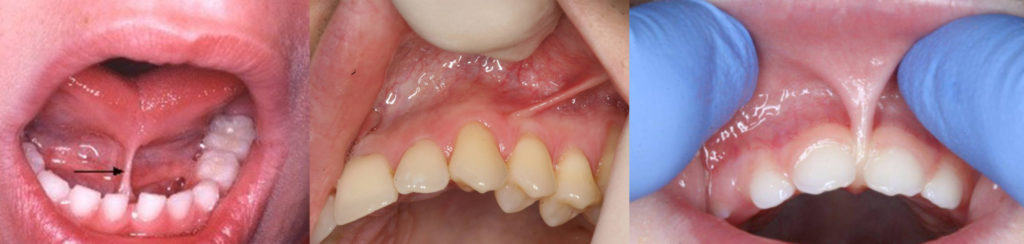
A tongue tie, or ankyloglossia, will present as an overly short or thick frenulum that restricts the tongue’s movement. Similarly, a lip tie can occur as well as buccal cavity ties. There are different classifications of each, however assessing function is what drives treatment or intervention.

Signs of TOTs in infancy may include difficulty breastfeeding causing failure to thrive and/or maternal pain. It can also be an issue causing “picky” eating or difficulty transitioning to solids. A child may develop a lisp due to structural problems and other issues may be evident across the lifespan. The following images depict restriction of the frena vs. supporting function.

What are all the Acronyms?

Let’s clarify the acronyms seen in the literature and on social media. These terms also identify team members when a tethering of tissue is present or identified.

  • TOTs – Tethered Oral Tissue
  • IBCLC/CLC – Individual/International Board Certified Lactation Consultant; if breastfeeding is an issue, this is one professional to consult.
  • SLP – Speech Language Pathologist; professionals who have training in feeding, speech, and oral sensory motor function. Can have training and/or a certification in orofacial myology.
  • OT – Occupational Therapist; can be TOTs informed and can assist in posture and alignment of the body, oral motor dysfunction, and body work such as craniosacral therapy or myofascial release.
  • PT – Physical Therapist; can be TOTs informed and have continuing education in craniosacral therapy, myofascial release, or more. There can be torticollis with tongue ties and PTs are essential practitioners in this area.
  • RDH -Registered Dental Hygienist; can be trained in orofacial myofunctional therapy.
  • OMD -Orofacial Myofunctional Disorder; one or more of the following can be an OMD: abnormal tongue resting posture, teeth grinding, lip incompetency and/or noxious oral habits, nasal breathing issues, tongue thrust swallowing, chewing difficulties, or oral placement issues related to speech.
  • OMT – Orofacial Myofunctional Therapy; a treatment modality used to treat OMDs. This is not a profession.
  • COM – Certified Orofacial Myologist; SLPs can become a COM, which is an extensive process involving clinical and written exams and continuing education requirements to maintain certification.
  • ENT – Ear, Nose, and Throat doctor or otolaryngologist. An ENT may assess structure, complete a release, and/or to assess an airway.
  • Dentist/Orthodontist – professionals on TOTs team for assessment and intervention.

What to do when Tongue Ties or TOTs are Present:

In infancy, a pediatrician can refer to IBCLC, SLP, etc. A diagnosis of TOTs does not immediately mean a release is necessary. An assessment of function will determine intervention. A speech language pathologist can conduct this assessment and be vital in pre-op care, post-op care, and functional therapy, whether oral sensory motor or orofacial myofunctional (only after the age of four). Following assessment, a release is considered with relation to age and the severity of the restriction both in classification and in function. A dentist or ENT may release a tie via laser or scissors. They will prescribe stretches to complete after the procedure, and an SLP can complete treatment in collaborative care if trained accordingly.

The Takeaway 

In conclusion, when researching a proper assessment of oral structures with possible restrictions, consult professionals knowledgeable in the area, whether dentist, SLP, PCP, IBCLC, or ENT. Function is a determining factor for the indication to release or not. Navigating TOTs is a team effort in evaluation and treatment. A speech language pathologist is a professional that can be instrumental in oral motor development, feeding, and speech across the lifespan, and orofacial myology after the age of four. Choose a team wisely! Untreated oral ties can lead to a host of problems, including dental and orthodontic issues such as altered jaw and teeth development, breathing issues, reflux, head and neck pain, chronic jaw issues and/or difficulty chewing, poor dental hygiene, digestive issues, sleep apnea, and speech issues.

If you are struggling breastfeeding, it may not be related to TOTs. Check out What Exactly is a Good Latch? for breastfeeding tips.

References
  1. Tongue Tie – What Everyone Needs to Know
  2. TOTs 101 for Parents

Visual Perceptual Skills

Curious about visual perceptual skills? Your occupational therapist may use a variety of terms to describe challenges your child may be having with vision. Firstly, it’s important to understand that when discussing vision, the term acuity refers to how well the eyes can see (i.e. whether or not a person needs glasses). Visual perception, however, refers to how the brain sees and interprets the information. Then, after ruling out other visual concerns related to acuity and oculomotor skills, your therapist may conduct a variety of visual perceptual tests.

Visual Perception Skill Assessments

The assessments your OTs have access to here at MOSAIC are: “Test of Visual Perceptual Skills”, “Motor Free Visual Perceptual Test”, and the “Beery VMI”. Some of the assessments test just the eyes and the brain’s interpretation, and some of the assessments test visual perceptual skills in combination with visual motor skills (involvement of the hand). Also, there are a variety of sub categories in most of these assessments:

  • Figure ground
  • Spatial relations
  • Discrimination
  • Form constancy
  • Visual and sequential memory
  • Visual closure

Therefore, all of these terms are skills kids need to be successful with school and everyday functions.

Visual Perceptual Skill Terminology

  • Figure ground refers to the eyes’ ability to see a specific item amongst a busy background. (Locating a specific sock in a busy sock drawer)
  • Spatial relations refers to the eyes’ ability to understand the position of objects in relation to oneself or in relation to other objects. (Spacing of letters on the paper in relation to the line or in relation to other letters)
  • Visual discrimination is the eyes’ ability to tell the difference of main features in an item’s position, shape, form, and color (Telling the difference between capital letters versus lower case letters)
  • Form constancy refers to your eyes’ ability to identify an item whether it’s upside down, turned over, a different color, or a different size (Being able to identify letters when looking at a newspaper from the other side of the table)
  • Visual memory and sequential memory are the eyes’ ability to look at something for a given time and be able to recognize it and its sequence after a brief lapse in time. (Remembering a family member’s phone number)
  • Visual closure is the eyes’ ability to recognize objects or letters when only parts of the item is visible. (Recognizing the item in a dot to dot picture)

How to get Help

Your child could likely have challenges with one or many of these sub categories. All areas of vision greatly impact your success with academics. For example, if you are seeing challenges with reading and writing, first be sure to rule out any visual concerns. Schedule and appointment with an optometrist before seeking further testing for visual perception. An optometrist will gather a baseline on acuity and oculomotor skills. But, if you aren’t sure and need more guidance, schedule a free screen with one of our occupational therapists. They will determine if your concerns warrant a full evaluation or a referral out to a vision specialist! Also, you can check out another MOSAIC blog on visual perception here.

Posture and Pain at Work

Have you had those days when you have been hunched over at your computer all day for work and start to notice a headache? Or, perhaps you’ve had neck pain that extends between your shoulder blades? Why is having good posture so important? What exactly does this look like?

Lower back pain is one of leading healthcare costs world wide, and many other people suffer from mid back or neck pain. One of the key elements that physical therapists will tune into is an individual’s posture, as this can be a contributing factor to your pain and decreased function. Posturing exercises are just some of the exercises that you may be performing in PT. However, even if you don’t need any physical therapy, it is important to keep good posture so you don’t develop any physical symptoms.

Posture and the Lumbar Spine

When addressing an individual’s posture, we need to focus on 3 areas of the vertebral column. The cervical spine, thoracic spine, and the lumbar spine. We need to build a good foundation from the base up, and the easiest place to start is with the lumbar spine. Often times sitting in a chair will cause a person to have a posterior pelvic tilt. This, in turns, causes the lumbar spine to flex forward. By teaching you the correct anterior tilt, we put the lumbar spine in its more natural lordotic position.

The Thoracic Spine

Now for the thoracic spine, we will often have our shoulder blades protracted (rounded forward) and thoracic spine flexed. In other words, increased kyphosis. This puts the muscles in our back on constant stretch. Even though it doesn’t feel like a traditional stretch, these muscles are getting lengthened all day long. In order to correct this, think about pinching a quarter blade between your shoulders. The key is to squeeze together and DOWN, not together and up. Elevating your shoulders will likely cause further tension/stress in your shoulders and neck.

Posture and the Cervical Spine

Lastly, we have the cervical spine. Usually, people are flexing their lower cervical spine and extending their upper cervical spine. We call this forward head posturing. To correct this, we perform a chin tuck. This is similar to trying to make a double chin in a goofy photo. By performing this action, we create extension in the lower cervical spine and flexion in the upper cervical spine.

Be sure to talk with your physical therapist about correct posturing. Each person is unique and needs their own individual exercise program. Additionally, it would be beneficial to review your workplace environment and make necessary changes. To help you get started, check out our Computer Workstation Setup Guidelines.

References
  1. Kim LH, Vail D, Azad TD, et al. Expenditures and Health Care Utilization Among Adults With Newly Diagnosed Low Back and Lower Extremity Pain. JAMA Netw Open. 2019;2(5):e193676. doi:10.1001/jamanetworkopen.2019.3676
  2. Mahmoud, N. F., Hassan, K. A., Abdelmajeed, S. F., Moustafa, I. M., & Silva, A. G. (2019). The Relationship Between Forward Head Posture and Neck Pain: a Systematic Review and Meta-Analysis. Current reviews in musculoskeletal medicine12(4), 562–577. https://doi.org/10.1007/s12178-019-09594-y
  3. Schünke Michael, Schulte, E., & Schumacher, U. (2011). In Thieme Atlas of anatomy (Second, pp. 2–35). essay, Thieme.

Dyslexia and Its Many Faces

Dyslexia is a well-known disorder that is characterized by difficulty with reading and writing. What is not well-known is that there are different types of dyslexia. Thus, children with a diagnosis of dyslexia or specific reading dysfunction may exhibit very different skills and challenges with regards to reading and writing. Griffin and Walton (Dyslexia Determination Test, 2003) listed the following seven different types.

Types of Dyslexia

  1. A dysnemkinetic label means poor memory for motor movements when printing or writing letters and numbers. Letter and number reversals are prominent and, generally, reading deficits are mild.
  2. A dysphonetic pattern presents with difficulty matching sounds to letters. This results in difficulty sounding out words and using knowledge of phonics to write words. This is evident in both phonetically regular words such as stop and phonetically irregular words such as cough. A typical spelling error might be solw for slow.
  3. A dyseidetic pattern presents with slow reading due to an over reliance on phonics to sound out words. A person cannot visualize the whole word and thus, recognize it by sight. Phonetically regular words (e.g. camp) will be read and spelled much more easily than sight words (e.g. laugh).

Mixes

The remaining four types are mixes, a combination of the above three primary types.

  1. This is a mix of dysphonetic and dyseidetic patterns resulting in difficulty recognizing sight word and using phonics to sound out and spell words.
  2. This is a mix of dysnemkinetic and dysphonetic patterns. Letter reversals are present and there is an inability to use phonics to sound out or spell words.
  3. This is a mix of dysnemkinetic and dyseidetic patterns. The difficulty will be reading and spelling of sight words. Letter and number reversals will also be present.
  4. This is a mix of all three primary patterns – dysnemkinetic, dysphonetic, and dyseidetic. Thus, deficits exist in letter and number orientation, matching sounds to letter symbols in order to sound out or spell words, and reading and spelling sight words.

Remediation will be most effective by identifying the type of dyslexia. Then, the teacher will select teaching techniques according to the type of dyslexia present. To learn more about how dyslexia affects learning, check out our blog, Understanding Dyslexia. For additional resources, check out The Dyslexia Resource.

Montana Outdoor Winter Activities

The holidays may be over, but winter is finally here. If you are like me and feel like you end up stuck inside all winter, hopefully this will provide you with some outdoor inspiration. There are a lot of outdoor winter activities great for children and adults alike here in Montana. Keep reading to find out my favorite activities to get you outside this winter!

The Best Montana Outdoor Winter Activities

Skiing

Skiing is usually the first thing that comes to mind when I think of winter and the outdoors, especially here in Montana. We are lucky, because we have two great facilities close to home. Both ski areas are a relatively short drive from Belgrade/Bozeman. If you are new to skiing, have no fear! Bridger Bowl and Big Sky Resort offer lessons for both children and adults, as well as kid camps. Both also partner with Eagle Mount to provide lessons for adaptive skiers, including those with developmental delays, visual impairments, spinal cord injuries, and amputees.

Sledding

Who doesn’t love hopping on a tube or a sled for a few runs down your favorite hill? If you have kids, this is a relatively fast and easy way to let them work out a little extra energy that is easily built up during these short winter days. Gallatin County Regional Park has a giant man-made hill perfect for sledding and well loved after a fresh snow. Snowfill Recreation Area also has a lot of great hills for sledding down, just watch out for dogs, since this is also an off-leash dog park. Another town favorite is Peet’s Hill. This hill is very well loved and the biggest sledding hill in Bozeman, so beware. It can become pretty icy, but it’s a great work out hiking back up each time.

Ice Skating

There are several places around Bozeman and Belgrade where you can lace up your skates and take a spin on the ice. In Belgrade, Kiwanis Park (702 Home Run Drive) has a seasonal ice rink and warming shelter. There is also a seasonal rink on the corner of North Broadway and West Park Street. In Bozeman, Beall Park, Bogart Pavilion, and Southside City Park all have ice rinks. If you’re new to ice skating or just want to give it a try before fully committing, Chalet Sports and Play It Again Sports both offer skate rentals.

Montana Outdoor Winter Activities – Hiking/Snowshoeing

Hiking is one of my favorite summer activities, but just because there is snow on the ground doesn’t mean you can’t still enjoy a good hike in the winter. There are so many trails around the area and if you are willing to drive out to Three Forks or Manhattan you are likely to find some trails without a ton of snow. The Missouri Headwaters State Park and Buffalo Jump State Park are two of my favorites. If you prefer a winter wonderland, Hyalite Canyon Recreation Area offers a lot of trails great for snowshoeing. If you don’t have your own snowshoes, no worries, Chalet Sports rents these out too.

Ice Fishing

Ice fishing is a great way to get outdoors during our long Montana winters. Sure, it might be cold, but it can be a fun and laid-back way to catch up with family or friends. This activity is best for those who already have the equipment or have a friend with equipment who wants to take you with them. Hyalite Reservoir is great for ice fishing. There is a five trout per day limit and graylings are catch and release. You can also ice fish at Glen Lake Rotary Park. Just remember, a valid fishing license is required!

montana outdoor winter activities

Cross Country Skiing

This is an activity I would like to devote more time to this year. If hiking and snowshoeing don’t appeal to you, cross country skiing may be just the right fit. You can still explore the beauty that winter in Montana has to offer. But, you can make it as easy or challenging as you like. There are several groomed trails around Bozeman and Belgrade.

The Bridger Ski Foundation grooms several trails in and around Bozeman, so you can find the perfect trail to meet your skill level. Trails are located at Bridger Creek Golf Course, Hyalite Canyon, Bozeman Creek, and Lindley Park. Bridger Ski Foundation has also put together a handy map showing the trails and skill levels.  If you are looking for a lovely area to explore that is more challenging, Crosscut Mountain Sports Center has several miles of beautiful terrain to explore, and they also offer lessons and rentals.

Montana Outdoor Winter Activities – Hot Springs

I saved my favorite for last. After a long day playing outside, there is no better way to unwind than with a soak in one of our hot springs. Bozeman Hot Springs, Norris Hot Springs, and Chico Hot Springs are all a relatively easy drive from Bozeman/Belgrade. Bozeman and Chico Hot Springs are open to the public daily. Norris Hot Springs is open Thursday through Sunday.

Hopefully this has filled you with inspiration to get outside this winter! You can also check out Exploring Yellowstone if you just want to jump ahead to planning for summer.