Prevent Falls

According to the CDC, there are more than 36 million falls each year, and 1 in every 5 of these falls results in a broken bone. To put this in perspective, every second of every day an adult over the age of 65 will have a fall. There are many contributing factors that can cause an adult to fall. These include weakness, medicines, home environment, community environment, nutritional status, and balance. So, how do we prevent falls? Physical therapists can help manage and lower the risk in many of these categories, but one area they specialize in is treating balance deficits. We all have 3 main systems that work together in order to maintain our balance. They are our vision, vestibular, and somatosensory (proprioception) systems. Let’s dive in and see how each of these function.

Prevent Falls by Improving Balance

Our vision is a critical component of our balance system. We rely on this for depth perception, peripheral vision, light/dark environments, acuity, etc. However, as we age, our vision slowly starts to deteriorate. We may become near or far sighted, we may develop other eye conditions such as macular degeneration, but we also begin to lose our sensitivity in low light areas. Maintaining a well lit home with nightlights is a great way to help reduce the risk of falls.

Vestibular

Our vestibular system is what detects linear and rotational movements. In other words, acceleration or deceleration of our body. It is responsible for our brain understanding if we are turning right, left, moving up, moving down, speeding up, or slowing down. It also helps to orient our head/eyes relative to the horizon. Try staring at a picture on the wall. Now, move your head to your shoulder and notice the orientation of the picture doesn’t change?

Somatosensory

Lastly, our somatosensory (proprioception) is made up of multiple different nerves in our joints, skin, muscle, and tendons. They help to detect stretch, pressure which, in turn, will tell if our body is touching the ground, or how our limbs, head, and trunk are all oriented relative to another. Try closing your eyes and touching your index finger to your knee or elbow or nose. We are sensing where our limb is in space.

Each of these is a key contributor to our balance. When one of these systems isn’t operating efficiently, it can confuse the other system and result in dizziness, loss of balance, or falls. Physical therapists will work to train these systems and help find other ways to prevent falls or lower your risk for falls. Before beginning any balance exercises, it is important to meet with a physical therapist so they can make sure you perform these exercises safely and correctly while also identifying your deficits to help achieve your goals. Don’t forget to check out How to Prevent Falls in the Winter Months for more tips.

References
  1. Avin, K. G., Hanke, T. A., Kirk-Sanche, N., McDonough, C. M., Shubert, T. E., Hardage, J., & Hartley, G. (2015). Management of Falls in Community- Dwelling Older Adults: Clinical Guidance Statement From the Academy of Geriatric Physical Therapy of the American Physical Therapy Association. Physical Therapy95(6), 815–834.

Oromyofunctional Disorders: What Exactly are They?

Orofacial myofunctional disorders (OMDs) are patterns involving oral and orofacial musculature that interfere with normal growth, development, or function of orofacial structures. Orofacial musculature dysfunction can occur at any stage in life. So, let’s look more into oromyofunctional disorders and how skilled treatment can help. (ASHA, 2022).

What can be addressed in oromyofunctional disorder treatment?

  • Obtaining proper lingual resting posture with tongue on palate
  • Breathing patterns, specifically promoting nasal breathing
  • Tongue thrust
  • Sleep breathing disorders
  • Oral habit elimination (i.e. finger/thumb sucking)
  • Temporomandibular joint pain
  • Long-term stability of orthodontic treatment
  • Tongue & lip tie
  • Difficulty chewing and/or swallowing
  • Articulation errors relating to atypical patterns

Who provides services for oromyofunctional disorders?

  • Speech-Language Pathologists
  • Occupational and Physical Therapists
  • Lactation Consultants
  • Osteopathic Physicians
  • Dental Hygienists, Orthodontists, and ENTs
  • Sleep Specialists and Craniosacral Specialists
  • Chiropractors and Massage Therapists

Overall, a licensed healthcare professional who has secondary training to support oromyofunctional disorders is a desired provider.

Goals of oromyofunctional therapy

The main goals of therapy are, firstly to establish nasal breathing. Secondly, to achieve tongue resting posture on hard palate. Thirdly, to correct atypical swallow and speech patterns (ie: tongue thrust). Providers work to achieve these goals through isolated jaw, lip, cheek, and tongue exercises with behavior modifications. Treating therapists work along with allergists, ENTs, and dentists when referral is necessary to address airway, dental occlusion, and tongue and lip tie confirmation diagnosis and treatment.

Bodywork is also another important component to achieve proper body posture. Proper posture helps to meet overall OMD goals. Therefore, the treating therapist would refer to a physical therapist if bodywork is needed. The remediation of oromyofunctional disorders improves overall facial structure, dental occlusion, and swallowing and speech impairments. To learn more about tongue ties and other tethered oral tissues issues, check out this MOSAIC blog. Click here to learn more.

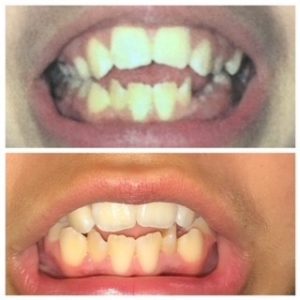
The pictures above refer to an 11 year old female at initial evaluation and then 6 months after. She completed oromyofunctional treatment for tongue thrust elimination. She achieved nasal breathing, proper tongue resting posture on palate, and eliminated tongue thrust swallow pattern in therapy. Her open bite improved greatly with the completing behavior modifications and isolated exercises in skilled oromyofunctional treatment. Subsequently, elimination of these behaviors will ensure her orthodontic longevity.

References
  1. “Orofacial Myofunctional Disorders.” American Speech-Language-Hearing Association, American Speech-Language-Hearing Association, https://www.asha.org/practice-portal/clinical-topics/orofacial-myofunctional-disorders/.
  2. “OMDs.” Function-Focus, www.function-focus.com/omds. Accessed 22 Feb. 2022.

Zingo For Family Game Night

Family game nights are a great way to bring everyone together for a little fun competition. They are also be a good way to boost language skills too! In addition to spending quality time with your family, playing games together can help with improving turn taking skills, attention, and cooperation. One great game to play with kids is Zingo.

What is Zingo?

Zingo is for kids four years and older. If you are willing to provide some extra help and attention, it can be played with children as young as two (with some modifications of course). This game takes a new spin on classic Bingo, and you can play with up to six people. Each player receives a board with 9 pictures and words on it. Then you take turns sliding the “Zinger” to dispense picture cards. The first person to fill their board is the winner.

Zingo Modifications

Zingo boards are two sided. The green side has fewer images in common so it is less competitive. The red side has more images in common so it is more competitive. You can modify game time by just trying to get three images in a row, or by matching the four corners. If you are playing a friendly game, you can pass the Zinger back and forth. The person whose turn it is gets those tiles or share them with someone in need.

You can also play that the first person to call out the tile they need gets it if you decide not to take turns being the dealer. If you want to add an exciting twist, you can play speed Zingo. The adult or dealer slides the Zinger and children race to grab the tiles they need without taking turns. Detailed instructions and tips on how to encourage more advanced thinking skills can be found here.

The Right Zingo for You

There are four different versions of Zingo to choose from. Original Zingo is a basic picture matching game. This is the best version for young children. Zingo 1, 2, 3 focuses on counting and addition. With Zingo Word Builder, you work to find missing letters to make words, and in Zingo Sight Words, you try to find matching sight words.

How to Encourage Language During Play

Use all of the Zingo games in different ways to build up your child’s expressive and receptive language skills. You can talk about the pictures, numbers, or words you find and what they mean. Take it to the next level. Find objects around the house that match the pictures or words on the tiles or make sentences using the target words. If you are playing number Zingo, you can count out your child’s favorite snack to go with the number they get. You can also use the boards to play “I spy” and work on describing and identifying the pictures. For example, “I spy something in the sky, it’s very hot, and it’s yellow.” If your child guesses “sun,” they get that tile.

There are so many different ways you can play this game to incorporate different skills. That is why it is always a go to game kid in speech therapy at MOSAIC. For more activities to do with your kids, check out our School’s Out Summer Activities and Infant Play Activities, and remember, if you have any questions about your child’s development, you can always call MOSAIC and speak to one of our skilled therapists.