
Balance Development: Birth to Three
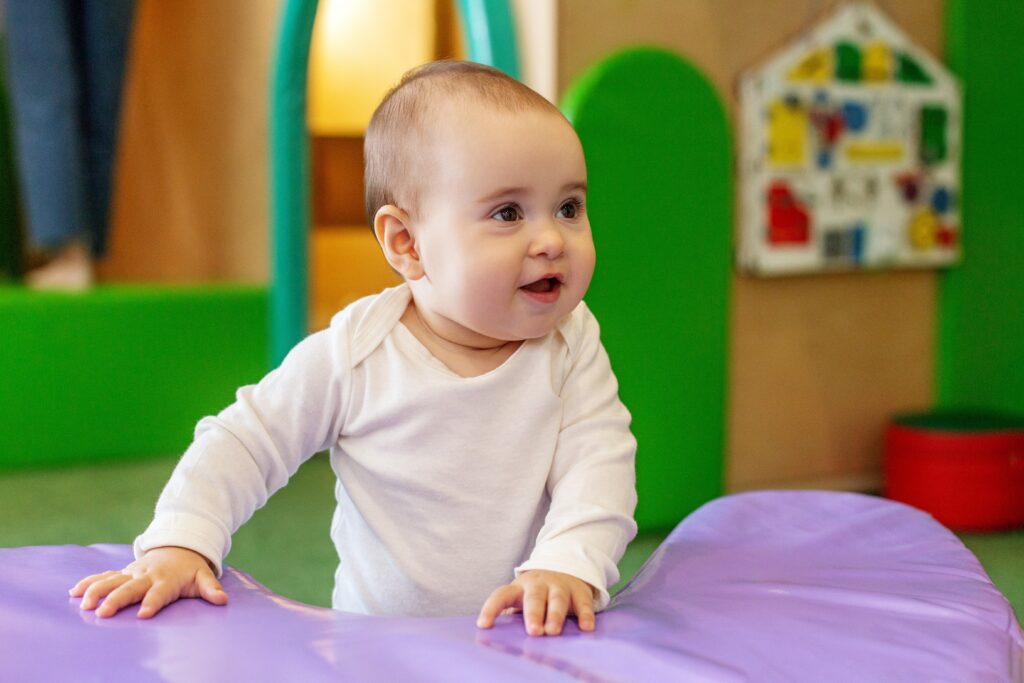
When a baby steadies their head, sits without support, or reaches for a toy without tipping over, they are already practicing balance. Later, balance helps that child walk, climb stairs, run across the playground, hop on one foot, ride a bike, and participate in sports. Balance development in kids is a gradual process—not one skill that suddenly appears. It grows as a child’s brain, muscles, joints, and sensory systems learn to work together. Every new movement gives the body more information and more opportunities to become steady, coordinated, and confident.
Children develop at different rates, so developmental milestones should be viewed as guideposts rather than pass-or-fail deadlines. The Centers for Disease Control and Prevention defines its listed milestones as skills that at least 75% of children can do by a particular age. Looking at a child’s overall progress is often more helpful than focusing on one isolated skill.
What Is Balance?
Balance is the ability to keep the body steady and controlled while staying still or moving. There are two general types of balance: Static balance is the ability to stay steady in one position, such as sitting upright, standing still, or balancing on one foot. Dynamic balance is the ability to remain controlled while moving, such as walking across an uneven surface, climbing stairs, running, jumping, or changing direction. Even simple movements require several systems to work together. The brain constantly combines and adjusts information from the visual, vestibular, and somatosensory systems. The way children rely on these systems changes as they mature.
- Vision helps a child understand where they are in relation to the environment.
- The vestibular system, located in the inner ear, detects head movement and changes in position.
- Proprioception, or body awareness, provides information from the muscles and joints about where the body is and how it is moving.
- Strength and postural control help the body respond to that sensory information and remain upright.
Balance Development occurs at Different Ages
Balance development follows a general progression. Children first learn to control their head and trunk, then maintain a position, shift their weight, move between positions, stand, and eventually control their bodies during faster and more complex activities.
Infancy: The Foundation
Balance begins developing during the first months of life. Before babies can stand, they must learn how to control their head and trunk against gravity. This is the foundation of balance. During infancy, balance development can be seen as babies learn to:
- Hold their head steady
- Roll from one position to another
- Sit with and then without support
- Reach for toys without falling over
- Move in and out of sitting
- Crawl or move across the floor
- Pull to stand
- Shift weight between their feet while supported
These early skills teach babies how to respond when their body begins to tip. Sitting, crawling, supported standing, standing independently, and walking are all part of the typical progression of gross motor development. Plenty of supervised floor play gives babies opportunities to explore movement and discover how different body positions feel.
12 to 24 Months: Learning to Walk and Recover
Early walking often looks unsteady. New walkers commonly use a wide stance, hold their arms up for stability, take short steps, and fall as they test their limits. As balance improves, toddlers begin to:
- Walk with a narrower stance
- Stop and start with more control
- Bend down to pick up a toy and stand again
- Turn while walking
- Step over small objects
- Carry toys while moving
- Begin running and kicking
As physical therapists, we want to see kids walking independently by 16 months. This is because, by 18 months, most children walk without holding on, take a few steps backward, and climb on and off a couch or chair. By age 2, kids should be running, kicking a ball, walking up a few stairs with or without help, and starting to try to jump. If a child isn’t walking at 16 months, then that child won’t be able to do these more advanced movements.
Some falling is expected during this stage. What families should generally see is gradual improvement in stability, confidence, and the ability to recover after losing balance.
Ages 2 to 3: Jumping, Climbing, and Exploring
During the toddler and early preschool years, children become more adventurous. They begin moving faster, navigating obstacles, and experimenting with both feet leaving the ground. Balance skills during this stage may include:
- Running with fewer falls
- Squatting during play
- Walking sideways
- Stepping over low obstacles
- Climbing playground equipment
- Walking along a wide line or low surface
- Going up and down steps with support
- Jumping with two feet
Toddlers may look steady in a familiar room but have more difficulty on gravel, grass, snow, playground surfaces, or crowded spaces. Different environments ask the balance systems to solve different problems.
Why Do Some Kids Have More Difficulty With Balance Development?
Occasional clumsiness does not automatically mean something is wrong. Children may have temporary difficulty with balance while growing quickly, learning a new movement, recovering from an injury, or entering an unfamiliar environment. However, ongoing balance challenges can be influenced by many factors, including:
- Reduced core, hip, leg, or ankle strength
- Limited joint mobility or muscle tightness
- Low muscle tone
- Joint instability
- Differences in foot or ankle alignment
- Visual difficulties
- Vestibular or inner-ear conditions
- Reduced body awareness
- Motor-planning or coordination challenges
- Developmental, neurological, or orthopedic conditions
- Pain, injury, or fatigue
- Limited opportunities for active movement and play
Balance is a whole-body skill. A child’s feet, posture, vision, inner ear, strength, coordination, and sensory processing may all influence how steady they feel. A pediatric physical therapist looks at these systems together rather than evaluating balance as an isolated problem.
When Should Parents Consider a Balance Evaluation?
Every child trips or falls occasionally. The pattern becomes more important when balance difficulties are frequent, worsening, or limiting participation. Reach out to MOSAIC if your child:
- Is delayed in sitting, standing, or walking
- Falls much more frequently than expected
- Is not becoming steadier over time
- Has difficulty navigating stairs or playground equipment
- Avoids running, climbing, jumping, or uneven surfaces
- Struggles to keep up with children of a similar age
- Consistently needs walls, furniture, or another person for support
- Shows a clear difference between the two sides of the body
- Walks with a persistent limp or unusual pattern
- Frequently walks on their toes
- Complains of pain or excessive tiredness
- Experiences dizziness, vertigo, or motion intolerance
- Has difficulty walking in dim lighting
- Suddenly becomes less steady
- Loses a skill they previously had
A balance evaluation does not automatically mean a child has a disorder. It can provide reassurance, identify areas that need support, and give families practical ways to help their child participate more confidently. Getting help as early as possible can make it easier to address balance challenges before they begin affecting a child’s confidence, independence, or participation in play, school, and sports.
Be sure to check back next week for our blog on how balance develops from age 3 through the school years!